
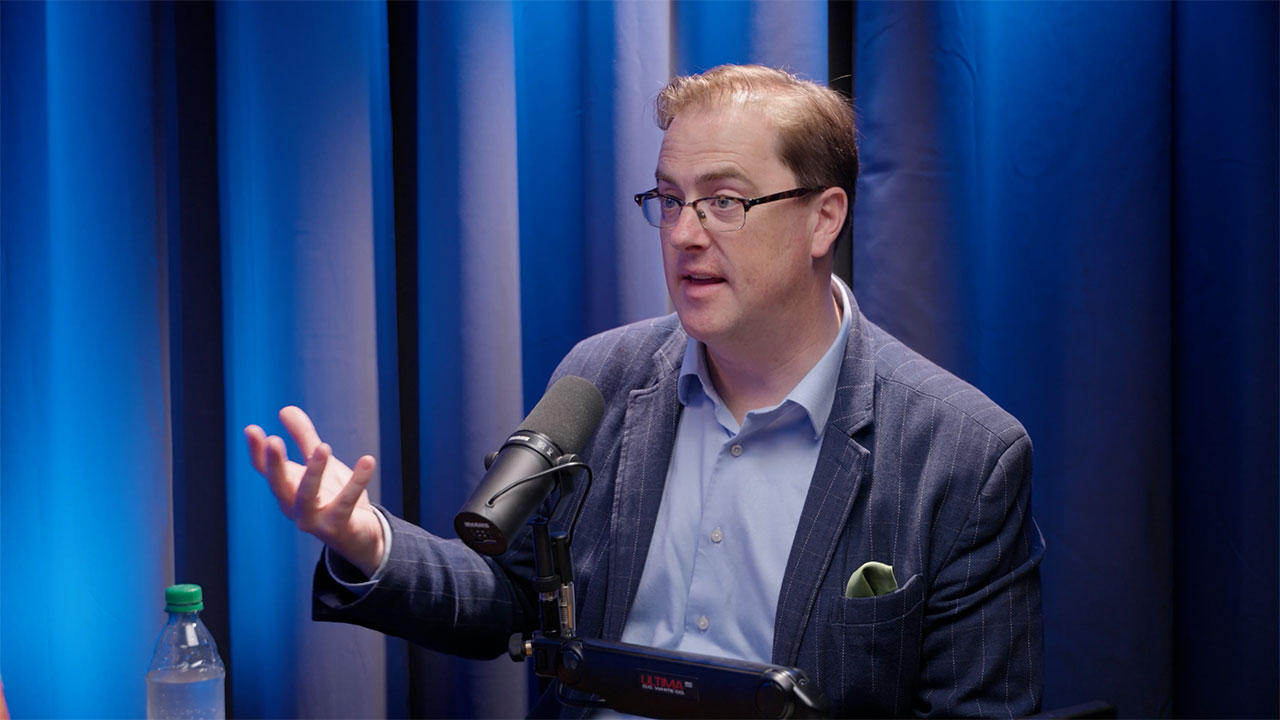
Matthew Mehan, author of “The American Book of Fables,” joins Bradley Devlin on a new episode of “Signal Sitdown“ to discuss the “moral imagination” of the Founders and the need during America 250 for the nation to have a “shared memory.”
This transcript has been lightly edited for clarity.
Bradley Devlin: Why did you write this book?
Matthew Mehan: So, I am a weird—I’m an odd duck in that I have both a lot of political training—political, philosophical, history, and civics training—but I also have literary training, and the two of those things kind of bounce back and forth, and so, you start to think about what is the role of a man of letters in a republic.
And it turns out that it’s a very sort of under-practiced art to give the right kinds of images that bring the right sort of ideas, habits, customs, principles, ways of being, and memory. That’s a major task that today’s poets don’t really do. And if they do it, they’re usually doing something wrong, or in error, or deliberately subversive, which we can talk about later, I guess.
But that just basically—I kind of wanted to come to the defense. Blood rushes to a wound, and this is something that needed doing, and so, I did it. That’s the simple answer. And then A250, the semiquincentennial—go big or go home for America’s 250th.
I wanted to basically, you know, drop a major heirloom, a kind of celebratory monster coffee-table epic, on the American family.
Devlin: Why fables? What’s important about a fable?
Mehan: So, one of the things I did to prep for this is I actually did study fables. I went to conferences like a good little nerd and read—you know, read up on—they have conferences—
Devlin: On fables?
Mehan: Very rarely. And sometimes you have to organize them yourself. But yes, I did. And then also I wrote for The Heritage Foundation, actually. I did a white paper on the founding imagination. What does the founding generation—what was in their imagination?
And it turns out what’s in your imagination is very much the ingredients for whatever stew of a decision—i.e., your prudence. What are you gonna do? Are you gonna found a new nation? Are you going to have a revolution? What are you gonna do?
And it turns out that what is in your imagination is a lot of what is the constituent parts of those acts.
So, if you have a poor imagination, you have an empty pantry, you will not cook a good dish, as Seneca says.
So, it turns out the Founders and the founding generation—they had these incredible Caxton’s fables, Avianus’ fables, “L’Estrange.” These were on the shelves. They would greedily buy copies of them. They read them and studied them. Why? Fables are not just—we think of “The Boy Who Cried Wolf,” right?
Simple, straightforward—”The Boy Who Cried Wolf.” It’s basically, if you lie, people don’t believe you, and then you get eaten by the wolf. Great, right? That’s a very good fable. But that is, in a certain sense, the exception to the rule.
It’s known because it’s the most simple today, and we tend to be morally a little too simple.
Most fables have a moral that’s basic, but then inside it, you feel that there is a lot more to think about—about how to be a good person and how to identify a bad person and how to react to evil so that you don’t become evil.
There’s actually the moral technology of fable. It’s a very witty, wise genre that is meant for a free people.
And so, that’s why I really focused on fable. And why, even though there’s nursery rhymes and there’s short stories and there’s primary sources, there’s a lot going on here. The central core is this beat of American fables—retold, adapted, and told wholly new.
Devlin: What’s the difference between mythology and fable? How does fable play into mythology and the relationship between those two things?
Mehan: Fable starts with the ridiculous—talking animals. It doesn’t give you any kind of easy ramp to slowly agree that, yes, the trees should talk. And it’s a kind of just instant absurdity, and that gives you a sort of distance from it to think about it as a fun kind of a game, a moral play.
Whereas myth is weaving history, the cosmos, angels and devils, gods and goddesses, naiads and dryads.
You’re making a full cosmic claim for your country, your nation, your republic inside of a wider providence of Jupiter or of God himself. You know—like it’s a much sort of bolder statement.
And myths can be true and myths can be false, right? They can be misleading and need purification. I mean, I think that’s Homer’s job—there are all these wacky myths in Greece at the time, and he’s like, “OK, I’m gonna—all the crazy ones, I’m gonna have this guy who’s crazy save them, and then we’re gonna put him in his place and tell a new one,” right?
So, he was trying to purify the myths of Greece to make the godhead of Olympus more reasonable. Now, as a Christian, we might go, “Yeah, that’s also bad,” but it was certainly philosophically better.
So, myth, to my mind, when you get to that level of complexity, it presents real dangers. But it’s fundamentally—every city, every founding, every country needs one, and so it better be really good and really true.
Devlin: America 250—you could have written a political book.
Why not a political book? Why not a philosophical treatise? Why not another deep dive into the history of the declaration?
Mehan: For a number of reasons. One very practical. First, not everyone is very patriotic. And if you actually want the entire country to be formed with a common memory of the principles and goodness of Judeo-Christian, Western, Greco-Roman—you can pick your hyphenated way of talking about what we have as a culture and as a people, right?
You need to find a way to attract them that isn’t only for those who are already kind of inclined in your direction, which is why there’s all these beautiful discourses on nature and the national parks and the ecology. Because even people who aren’t very patriotic still love the national park system.
They like backpacking. They like the buffalo. They want to protect nature.
So, in one sense, we have to always be struggling for a national book, right? For a national dialogue, a national memory—or we’re gonna tear apart, right? That’s gonna happen.
And this is part of what I’m trying to do: give the country a shared memory again.
And then, through that, they come to know some of the things that we sort of—more patriotic, more kind of conservative, whatever term you want—that care about these things: the morals of fables, right, the moralists, which I’m all about.
One thing I learned is the Founding Fathers were so—and the founding generation—their moral imagination was so much more intense than ours.
Everything was moralized. But it was actually joyful. It wasn’t this sort of frowning misery of, like, lectures. It was this hilarious wit and wisdom that was downright funny. But they could judge very carefully …
…
The American founding is different. It’s all written down. Like, we have the letters. We know what the—Numa, the king of Rome, wasn’t, like, magically talking with a nymph, and we don’t really know what happened there, right?
Like, these are letters between Abigail Adams and John Adams, and then between Jefferson and Washington and Adams. Like, we know what happened in a funny way, and we’re also from the Anglo-Saxon tradition of the droit écrit, the written law.
So, we actually like to write things down. We like things to be clear, which presents a challenge for myth, because we’re not going to accept some fake godhead.
I think we love “The Song of Hiawatha,” and I have a kind of nod to it. But we rejected a lot of what Longfellow was doing with this strange sort of foreign gods, new mythology for America—Hiawatha on the mountain with these … No, we’re Christian, right? We’re Western. We’re sort of rational.
And so, humanity winds up having a lot of primary sources in history, and the mythos winds up being a kind of true mythos of the moral wit and wisdom of the people. And the mystery of the myth actually is the numinous reason of the American people.
Like, we are a mysterious thing, right? And it’s amazing that we produced what we produced, yes, through our representatives.
But I try to get past—yes, the Founding Fathers. I focus on them. I raise them up as heroes and show some of their strengths and even some of their weaknesses, such that we can even learn from their mistakes. But also, I try to get past that to the American people and the settlement of the country, which is why the book doesn’t just do the founding and the Revolution.
It does that, interspersed with an account of the settlement and all these other sort of very moving lesser biographies and stories of the settling of the country.