
May 27, 1941: The Navy pilot of the Douglas SBD Dauntless Dive Bomber was trying to find a nice quiet place to land where he could haul in the tow sleeve target he’s been dragging around for other planes to practice on. Mmmm…that Marine airbase on Ewa, Hawaii, looked inviting. Upon landing, though, his prop churned up a huge cloud of red dust, preventing two squadrons of Marine fighters from landing.
“Unknown dust cloud, who the hell ARE YOU?!” the tower radioed. Discretion being the better part of valor, the pilot took off as fast as he could, hoping his plane wouldn’t be recognized, but upon his arrival at his own base a buddy had seen the whole thing. “Welcome aboard, Dusty!” That name stuck for the rest of Norman Jack Kleiss’s career.
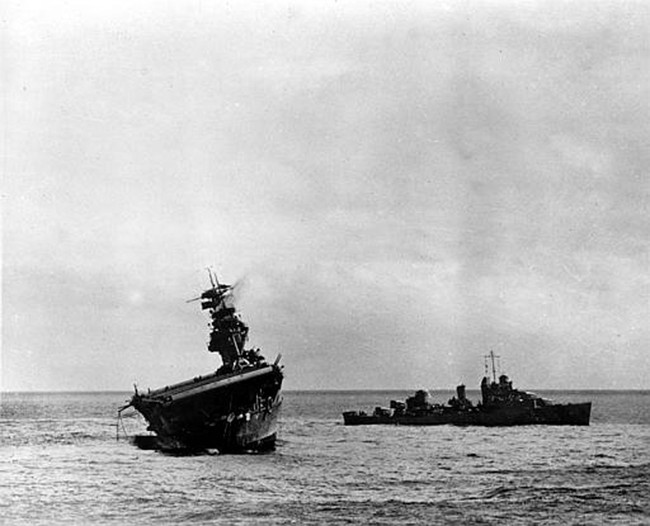
The Doolittle Raid in April of 1942 had shocked the Japanese imperial high command into speeding up plans for a Central Pacific drive to lure out the American fleet and destroy what they thought was left of it. The Battle of the Coral Sea, the first major aircraft carrier battle in history, had badly damaged the USS Yorktown. The Japanese thought she was at the bottom of the sea, or soon would be. Unknown to them, she had limped back to Pearl. Under normal circumstances, it would have taken 90 days to repair her. Admiral Nimitz sloshed around in wading boots in a not yet fully drained drydock and told them flat out he wanted her out to sea in three days. Working day and night, patching her as best they could. THEY DID IT. They had to. Nimitz knew the Japanese were coming, but headed where? And precisely when?
Rochefort, the eccentric Navy cryptanalyst whose normal attire was a smoking jacket and slippers, got an idea. The Japanese code for their objective was “AF.” Suspecting it might be Midway, a false message was sent in the clear that the water desalinization plant on Midway had broken down. Sure enough, the Japanese radio station on Wake sent a message that AF would be short on water, and to bring extra water along.
In order to place his carriers in the proper position to spring a trap, though, Nimitz had to know WHEN. Rochefort was up all night May 23-24 trying to squeeze what he could out of a new Japanese code. He arrived late and bleary-eyed to a meeting with Nimitz, but told him what he needed to hear: the Aleutians would be hit on June 3, and Midway on June 4. More information was obtained until Commander Layton, chief fleet intelligence officer, confidently told Nimitz: “They’ll come in from the northwest on a bearing 325 degrees and they will be sighted at about 175 miles from Midway, and the time will be about 0600 Midway time.”
In the event, Layton was only off by 5 degrees, 5 minutes and 5 miles.
Four Japanese carriers and a battle group steamed towards Midway. The U.S. carriers got their planes aloft, but carrier combat was new, and confusion reigned. Formations broke up. Torpedo squadrons found the Japanese fleet, but were without fighter cover, without smoke screens, and flying slow-moving craft with faulty torpedoes. They would be mincemeat for Japanese Zeros, but they went in anyway. Most never came back.
Meanwhile, Dusty’s air group commander, C. Wade McClusky, spotted a lone Japanese destroyer, the Arashi. Low on fuel, McClusky took the risk of following its heading. Payday! The Japanese carriers had been changing bombs, not sure whether they should hit Midway again (their first strike was devastating but not complete) or be ready to attack American carriers that might be nearby. In a stroke of American fortune, the Japanese recon plane headed in the direction of the American fleet was late taking off, late to report, and only saw one carrier. As Dusty and his companions came in, with sun behind them like western gunfighters, the decks were full of bombs and fuel. The Zeros, and the Japanese command, were focused on the torpedo bombers coming in at sea level. Dusty went into his 250 MPH dive, aiming for that big red “meatball” on the flight deck of the Kaga, and then pulled his bomb release lever, and then his stick, as hard as he could. Direct hit! Other pilots also scored hits on the Kaga, the Akagi and the Soryu. In less than five minutes three Japanese aircraft carriers were headed for the bottom of the sea, and the tide of the Pacific war had turned.
Dusty’s day was not finished, though. The Hiryu was still in action, and its planes swarmed the hapless Yorktown, crippling her again. The Enterprise turned into the wind to avenge the Yorktown, and Dusty was airborne once more. His squadron found the Hiryu, and Dusty dove again, putting one right into her bow. Other direct hits sealed her fate. The next day, Dusty took off again, this time to attack what was left of the retreating Japanese. He put another one into the smokestack of the cruiser Mikuma. Dusty was the only pilot to score three direct hits with his SBD during the Battle of Midway. For that, he received the Navy Cross.
Dusty’s skill made him too valuable to risk, and so he was sent stateside to train the next generation in this new kind of warfare. Norman Jack “Dusty” Kleiss lived to be 100 years old.
The following year the United States would produce 14 fleet carriers, and by the end of the war, 34 would be afloat, swarming the Pacific. The last time the Japanese sortied out en masse to engage those carriers was at the Battle of the Philippine Sea in June of 1944, which was such an overwhelming American victory it was nicknamed the “Marianas Turkey Shoot.” Japan had lost most of its best skilled pilots at Midway. The Japanese had to try, though, because the Americans were securing the Mariannas, and from them round-the-clock B29 bombing of the Japanese homeland could begin. The Enola Gay (named after Col Tibbetts’ mother) would take off from Tinian.
The Battle of Midway could be compared to Pickett’s charge at Gettysburg, considered the high-water mark of the Confederacy, but Midway was much more than that. Considering the suddenness of the turnaround (three carriers destroyed in five minutes!), the immense risks taken, and the decisiveness of the result, one can easily sense the hand of Providence.
Editor’s Note: Do you enjoy PJ Media’s conservative reporting that takes on the radical left and woke media? Support our work so that we can continue to bring you the truth.
Join PJ Media VIP and use promo code FIGHT to receive 60% off your membership.