

This morning’s Gospel reading is John 14:1–12:
Jesus said to his disciples:
“Do not let your hearts be troubled. You have faith in God; have faith also in me. In my Father’s house there are many dwelling places. If there were not, would I have told you that I am going to prepare a place for you? And if I go and prepare a place for you, I will come back again and take you to myself, so that where I am you also may be. Where I am going you know the way.” Thomas said to him, “Master, we do not know where you are going; how can we know the way?” Jesus said to him, “I am the way and the truth and the life. No one comes to the Father except through me. If you know me, then you will also know my Father. From now on you do know him and have seen him.”
Philip said to him, “Master, show us the Father, and that will be enough for us.” Jesus said to him, “Have I been with you for so long a time and you still do not know me, Philip? Whoever has seen me has seen the Father. How can you say, ‘Show us the Father’? Do you not believe that I am in the Father and the Father is in me? The words that I speak to you I do not speak on my own. The Father who dwells in me is doing his works. Believe me that I am in the Father and the Father is in me, or else, believe because of the works themselves. Amen, amen, I say to you, whoever believes in me will do the works that I do, and will do greater ones than these, because I am going to the Father.”
“What is truth?”
In today’s Gospel, Jesus teaches that He is not just the way to eternal life, but also truth itself. But this recalls Pontius Pilate’s question, which rings down from the Garden of Eden to the present day. What exactly is truth, and can we know it? Pilate failed this test, as did Adam, and as we all do when we choose sin and disobedience over the way and the life.
The reason for this is simple: It’s a trick question.
The Garden of Eden story in Genesis teaches us this lesson. The Lord created Adam and Eve to live within His divinity to love each other fully and to love Him fully as well. To do that, Adam and Eve needed to recognize the Lord’s authority as their Creator, allowing Him to lead them and live full lives as themselves within the perfect truth of His love. Through their love and trust in the Lord, He would make them stewards of all Creation, to live in harmony and abundance.
The serpent appears, however, and convinces them that the Lord is hiding truth from them and oppressing them from their own destiny as gods of equal stature. The serpent lures them into disobedience and rebellion – the original sin of revolt against the Lord’s authority – and fall out of grace with Him. Not only does this revolt result in losing access to the Garden of Eden and the divine life, it also disconnects them from the truth of the Lord’s authority and love.
There is no interpretation of this scripture in which Adam and Eve find The Truth; instead, they and all their descendants remain lost from the totality of the Truth of the Lord’s nature, to this day. The concept of truth itself fractures, based on the fracture of Original Sin. We continue to aspire to be our own gods, the creators of our own realities, in which truth becomes our own fantasy to suit our corrupted appetites and ambitions.
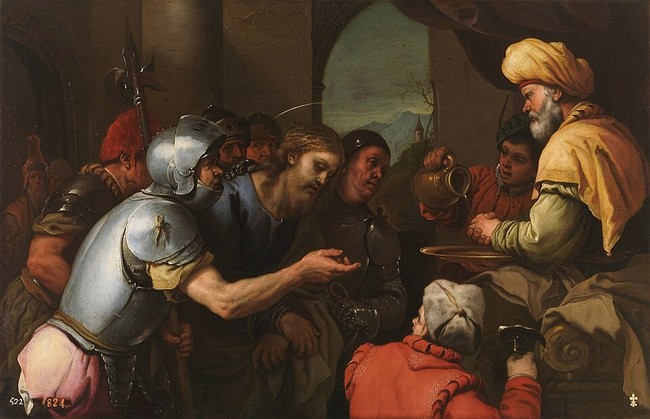
Pilate’s question provides the nadir of this affliction. In John 18, Pilate tries Jesus on the basis of the incomplete and contradictory testimony of the temple authorities. Pilate has good reason to know that the charges are false, and in fact determines that Jesus has not actually broken the law within his jurisdiction. He understands that much of the truth of the situation, and yet literally washes his hands of it rather than acknowledge it. He asks the famous question first, “What is truth?”, and then condemns Jesus in complete defiance of it for the sake of Pilate’s own version of “truth.”
However, Pilate is hardly alone in this sin. The Lord sent prophets by the boatload to tell the Israelites and later the Judeans to turn back toward Himself and trust in His love and leadership. Sometimes they obeyed for a while, but more often they rejected and persecuted the prophets to pursue their own limited vision of “truth.” The reason for this is that we live our lives disconnected from the divine life of the Trinity, which makes us unable to see the fullness of truth. We are too caught up in our appetites, ambitions, and desires to consistently glimpse objective and full truth.
The question “What is truth?” is not just a trick question. It’s a trap, an impossibility, and a form of blindness by which we get lost.
Last weekend, we celebrated the Good Shepherd image of Christ, and this Gospel passage may exemplify it even better. In it, Christ is speaking to the lost lambs of the Father, calling them home through Jesus’ voice. Today’s responsorial from Psalm 33 reminds us of our need to trust in the Lord rather than rebel against Him: Lord, let your mercy be on us as we place our trust in you. Trust is another word for faith. Adam and Eve lost faith in the Lord when the serpent entered the Garden. We abandon faith for rebellion when we sin and make ourselves into our own gods.
In today’s Gospel, Jesus is not explaining the fullness of truth. He is asking the disciples for faith, for their trust in His love and power as a Good Shepherd to show them the way to The Truth. “I am the way,” Jesus says, the path for the blinkered and nearly blinded to follow back to the pasture of the Lord. As one of the three Persons of the Trinity, Jesus is the Truth embodied in flesh. It is not necessary to grasp that Truth fully to be His disciple, which is vital to us because we are incapable of that in our fallen state. All we need is to have faith and trust in Jesus that He is the Truth, and His Way will lead us to Him, and through Him to the Father back to the home the Lord always intended for us.
Previous reflections on these readings:
The front page image is “Christ before Pilate” by Luca Giordano, c. 1655-75. On display at the Museo del Prado in Madrid. Via Wikimedia Commons.
“Sunday Reflection” is a regular feature that looks at the specific readings used in today’s Mass in Catholic parishes around the world. The reflection represents only my own point of view, intended to help prepare myself for the Lord’s day and perhaps spark a meaningful discussion. Previous Sunday Reflections can be found here.
Editor’s Note: Our Sunday Reflections are free to all readers, but our VIP members help keep this platform going for everyone. Join the effort by using the promo code FIGHT to get 60% off new memberships and upgrades to VIP Gold and VIP Platinum!