

Virginia Democrats are doing an unwitting service to the whole country — by revealing just how hostile their party is to the most essential checks and balances.
Democrats violated the state’s constitution by pushing through a referendum to take four congressional seats away from Republicans.
But when Virginia’s supreme court threw out the illegal map, Democrats didn’t back down:
They started thinking of ways to get rid of every justice on the court, so they could pack it with new ones expressly picked to return a verdict more favorable to the party.
If the Democrat-controlled Virginia legislature could impose a mandatory retirement age of 54 on the justices — who are all older than that — they could be removed and replaced by compliant partisans.
This wasn’t just a harebrained scheme by state Democrats; this was discussed on a call with the highest-ranking Democrat in the U.S. House of Representatives, Minority Leader Hakeem Jeffries.
As breathtaking as this power grab might be, it’s consistent with the thrust of the national party’s thinking about doing away with troublesome constitutional checks.
Democrats have been arguing for decades to weaken or eliminate protections built into the Constitution to prevent a self-interested faction or party — even one with a short-term electoral majority behind it — from seizing total power.
Virginia today is exactly what James Madison and other framers of the Constitution were afraid of:
A faction — the Democrats — is using its success in the most recent election to try to rewrite the rules for future elections and is prepared to intimidate or destroy any institution that stands in its way, including the state’s supreme court.
Virginia is not a solid-blue state — just a year ago, it had a full slate of Republican statewide elected officers.
Its congressional delegation is split, six Democrats to five Republicans.
It may presently be out of reach for Republicans in presidential elections, but its legislative races and contests for statewide offices are competitive — Republicans had a majority in the House of Delegates as recently as three years ago.
Indeed, Virginia is so politically balanced that Democrats try to put a moderate face on their party by picking the likes of Abigail Spanberger, Mark Warner and Tim Kaine for governor or U.S. senator, candidates who present themselves as centrists.
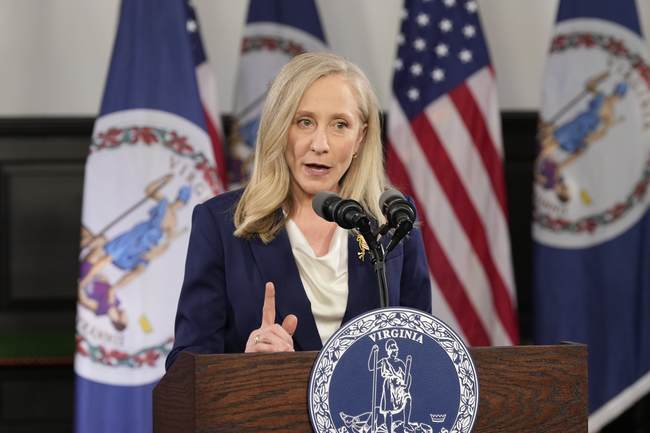
Yet once Spanberger was sworn in as governor this year, with Democratic majorities in the general assembly, the push was on to throw the state constitution aside and redraw the congressional map to give Democrats 10 seats to one for the GOP, and now the justices who stopped that gerrymander face the party’s wrath.
Virginia’s constitution doesn’t seem to allow removal of sitting justices by imposing a mandatory retirement age.
But it’s the thought that counts — and this one is of a piece with the way Democrats nationwide think about not only the U.S. Supreme Court but also the Electoral College, the filibuster and the U.S. Senate itself.
Democrats are even in the habit nowadays of claiming elections for Congress are unfair if the results of the national “popular vote” in House races don’t match who wins the most seats — as if lopsided Democratic majorities in California should have any bearing on who voters in Tennessee or Virginia pick to represent them.
Democratic Party activists and ideologues have long argued the Constitution’s fundamental design is unfair because it doesn’t give short-term majorities absolute power and protects small states from being overrun by the votes of large states.
Yet their arguments are as inconsistent as they need to be for the party’s benefit:
Many of the same liberals who complain the Senate is inherently undemocratic also want to admit Washington, D.C. and Puerto Rico as small states with two senators apiece.
Arguments aimed at delegitimizing the Senate — and Senate institutions like the filibuster — and the Electoral College and even House elections when the results aren’t to Jeffries’ satisfaction are just variable means to a consistent end: the Democratic Party’s power.
Yes, Republicans gerrymander, too:
Redrawing legislative districts for partisan advantage has been a feature of American politics since almost the beginning — Elbridge Gerry, the namesake of the practice, signed the Declaration of Independence.
But Virginia’s Democrats didn’t just gerrymander; they violated a constitution to do it, and are contemplating going even further to manufacture a supreme court that treats the party’s will as law.
If this were just one state’s story, it would be bad enough.
It’s not, though — talk of packing the U.S. Supreme Court to force it in a progressive direction, demands that presidential and congressional elections reflect national majorities of the moment, and other radical ideas bandied about by Democrats from one coast to the other are a threat to the rule of law everywhere.
It’s a threat that won’t go away until it’s finally carried out — or until Democrats are rebuked hard enough at the ballot box that they’re forced to moderate.
Editor’s Note: Do you enjoy PJ Media’s conservative reporting that takes on the radical left and woke media? Support our work so that we can continue to bring you the truth.
Join PJ Media VIP and use promo code FIGHT to receive 60% off your membership.