

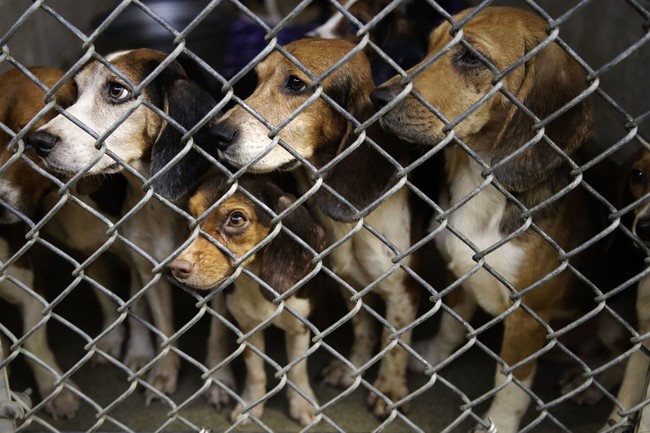
News outlets and social media feeds in recent weeks have repeated the images: on April 18, activists trying to free dogs from a notorious Wisconsin breeding facility were pepper-sprayed and shot with rubber bullets by police. Now, Ridglan Farms has agreed to sell many of the dogs to animal welfare groups. But the people who tried to free the beagles from the facility were spurred not only by the documented animal abuse inside, but also by the experiments in which the animals were slated to be used.
Canine factory farms like Ridglan are kept in business by experimenters who receive fat checks from the U.S. government. On that bigger issue, news broke last week that received far less attention. The oldest taxpayer-funded dog experiments in the country, begun in 1991 at Wayne State University in Detroit, have stopped — for now. But the lingering question is whether the National Institutes of Health will leave the failed project in the past or reanimate its corpse — an appropriate analogy considering the agency gave Wayne State almost $15 million to kill more than 300 dogs. It’s up to NIH Director Dr. Jay Bhattacharya and Health Secretary Robert F. Kennedy Jr. to decide what comes next.
In recent years, Wayne State purchased dogs not from Ridglan but from the western New York breeding facility of international corporation Marshall BioResources. While whistleblowers have leaked images from inside Marshall, we know far more about what happened to the dogs after they reached the university’s windowless, basement lab.
Thousands of pages of public records obtained from Wayne State over the past 15 years reveal that university employees, funded by the NIH, implanted devices in and around the dogs’ delicate arteries, stabbed wires into their hearts, and inserted needles into the space around their spines. The devices were attached to cables tunneled under the dogs’ skin and out through incisions made between their shoulder blades.
Wayne State then triggered the implanted devices to artificially create heart failure. While the dogs ran on treadmills, their heart rate was raised two to three times what is normal day after day for weeks or even months. But most dogs didn’t live that long. The university’s own records show many dogs (usually beagles since Wayne State stopped buying shelter dogs in 2013) suffered painful, fatal complications due to botched surgeries.
In September 2021, Wayne State put Dog 1002, barely a year old, out of her misery only after realizing she was struggling to breathe. A device implanted by Wayne State staff had torn a hole in her aorta, the largest artery in the body, and 1.5 liters of blood had painfully pooled around her lungs.
In August 2024, Dog 3003 suffered “rigid paralysis” after a procedure near his spine. Wayne State’s records make clear he was “vocalizing” in pain before he was killed. When we asked the university for a report of the dog’s necropsy—often conducted when an unexpected death occurs—Wayne State said it had not conducted one because “the case was not unique.”
Those are just two examples among hundreds. Yet despite all that death, there is no evidence that human patients suffering from or at risk of heart failure have benefited from what the NIH funded at Wayne State.
In 2025, Wayne State claimed its experimenters discovered that measuring the stiffness of a patient’s arteries can help predict whether he or she will experience low blood pressure during surgery. That is, indeed, an important discovery, but there is zero evidence that it came from Wayne State. Instead, researchers in Iowa and Illinois, France, and elsewhere have examined this issue in studies with human patients.
For Our VIPs: Touching the Ground for the First Time
Considering its failure, why would Wayne State go to such lengths to keep this useless project going? Money. In 2024, the last year for which data is available, the NIH awarded the university $682,656 to kill dogs in heart failure experiments. At that time, Wayne State’s “indirect cost rate,” the amount of money per project the university receives for general expenses, was 54%, meaning that year it pocketed more than a third of a million dollars because of a single grant.
Why would the NIH even consider giving Wayne State more money? After all, Dr. Bhattacharya announced on Fox News in May 2025 that it had closed its last in-house beagle lab. Days earlier, the agency stated it would “prioritize human-based research technologies.” And in March this year, it announced plans to invest $150 million to “develop more sophisticated and relevant models of disease.”
While there is nothing sophisticated about Wayne State’s crude experiments, that’s not true of research elsewhere. Three-dimensional models known as organoids, derived from human cells, replicate the function of the heart, providing data relevant to patients. Other researchers use diseased hearts from patients undergoing transplants or hearts donated for research to conduct studies. Some scientists realized long ago that dogs are unnecessary for cardiovascular research: the Texas Heart Institute stopped using dogs in 2012 because “the canine physiology is not the optimal match…”
A vast majority of Americans believe the federal government should do more to address its funding of the experiments that keep breeding facilities like Ridglan and Marshall in business. The NIH can send a clear message to those taxpayers by cutting off money to Wayne State’s dead-end experiments.
Editor’s Note: Do you enjoy PJ Media’s conservative reporting that takes on the radical left and woke media? Support our work so that we can continue to bring you the truth.
Join PJ Media VIP and use promo code FIGHT to receive 60% off your membership.