
Iran has reportedly offered to reopen the Strait of Hormuz if talks around its nuclear program are postponed to another time.
The proposal would offer an accelerated path to ending the war. Yet President Trump is eager to maintain his blockade of Iranian ports during negotiations over Iran’s enrichment program.
The White House hinted at this leverage in its comment on the proposal, which Axios first reported.
“These are sensitive diplomatic discussions, and the U.S. will not negotiate through the press. As the president has said, the United States holds the cards and will only make a deal that puts the American people first, never allowing Iran to have a nuclear weapon,” White House spokeswoman Olivia Wales said.
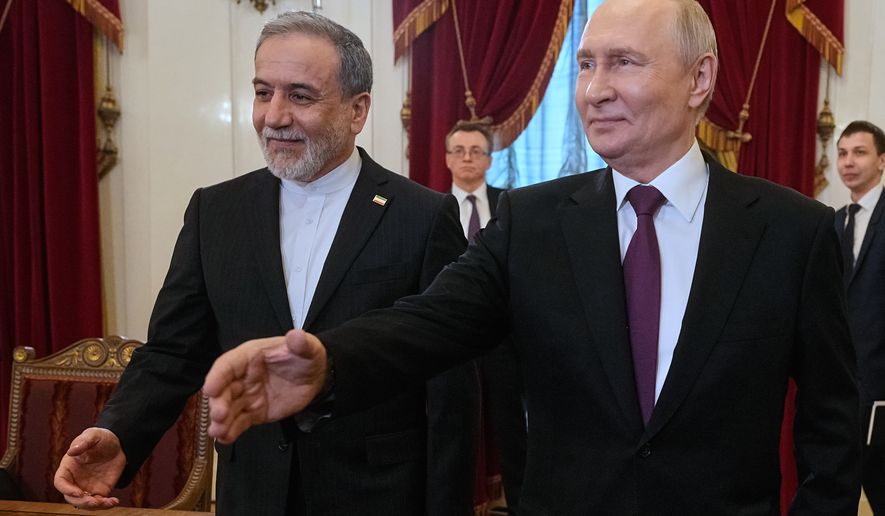
Russian President Vladimir Putin, right, and …
more >
The U.S. and Israel launched a military operation against Iran on Feb. 28 to prevent Tehran from gaining a nuclear weapon while curtailing its missile program and support for terrorists in the Middle East.
Over the weekend, Mr. Trump told his envoys to stay home instead of traveling to Pakistan for peace talks, citing conflicting messages from the Iranians.
SEE ALSO: Iran returns to Pakistan for peace talks as Trump tells U.S. delegation to stay home
He says Tehran is under pressure to make a deal, not the U.S., as the conflict shifts from a kinetic war to a battle of economic will-power on either side.
Mr. Trump imposed a blockade of Iranian ports, hoping to force Tehran to the negotiating table. But Iranian restrictions on the Strait of Hormuz are choking off critical supply chains for oil and other materials.
Secretary of State Marco Rubio, speaking to Fox News on Monday, said Iran is “worse off and weaker” than it was before the war, when it suffered from droughts and protests tied to economic concerns.
He said for that reason, some in Iran are serious about making a deal.
However, “one of the impediments here is that our negotiators aren’t just negotiating with Iranians,” Mr. Rubio said. “Those Iranians then have to negotiate with other Iranians in order to figure out what they can agree to, what they can offer, what they’re willing to do, even who they’re willing to meet with.”
European and Asian allies are particularly bitter about energy shortfalls, and airlines have canceled flights due to fuel shortages.
SEE ALSO: European Commission President Ursula von der Leyen: Too soon to remove sanctions on Iran
American consumers have not felt quite the same pinch, though gasoline costs are rising alongside oil prices.
The U.S. average price of a gallon of gasoline stood at $4.11 on Monday, a 2-cent increase from the prior day, according to the AAA motor club.
Regular gasoline cost around $3 per gallon at the start of the war.
“The Strait of Hormuz is closed, gas prices are soaring and billions of taxpayer dollars have been wasted,” House Minority Leader Hakeem Jeffries, New York Democrat, wrote Monday on X. “How is this reckless war of choice working out for the American people?”