
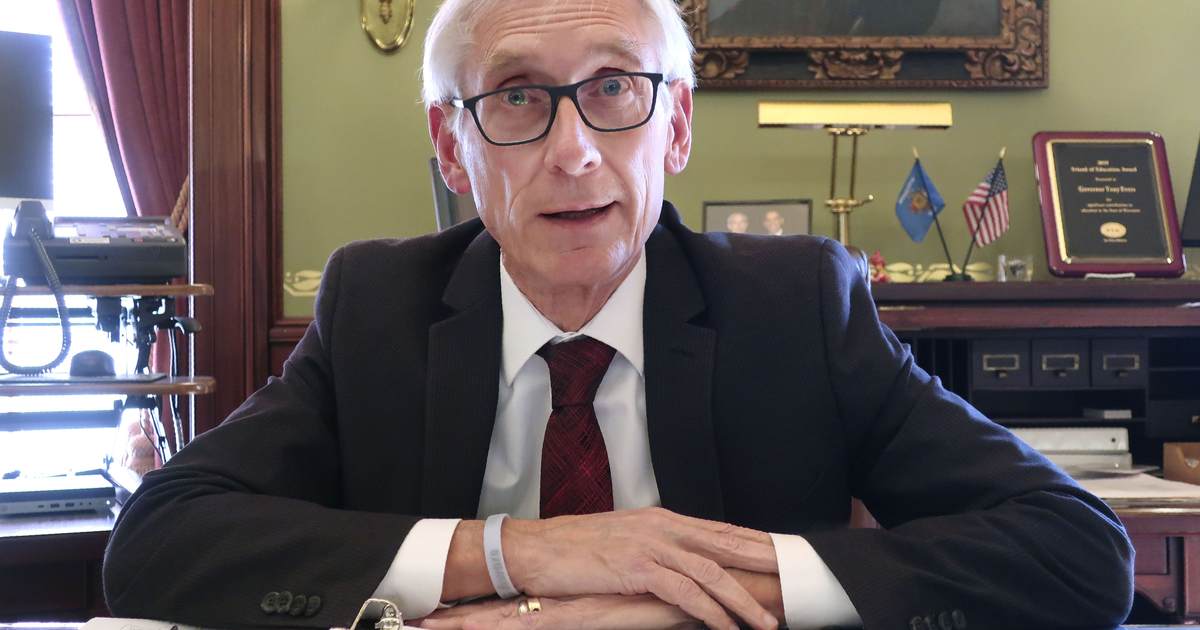
Tony Evers looked at a two-year school funding provision and found room for four centuries. On Tuesday, Wisconsin voters can tell future governors that the power to delete a few characters shouldn’t include the power to authorize higher taxes.
In 2023, the state’s legislature approved annual increases of $325 per pupil in school district revenue limits for two school years. Evers used partial vetoes to extend those annual increases through 2425, celebrating the result in his own announcement.
Apparently, planning for the next budget wasn’t ambitious enough. Wisconsin needed a governor willing to finish the paperwork for descendants whose great-grandparents haven’t been born.
The mechanism matters. Revenue limits govern the combined amount districts can collect from general state aid and local property taxes. Evers expanded their revenue authority; he didn’t automatically raise every homeowner’s tax bill. The change allowed districts to collect more property taxes when state aid didn’t cover the additional capacity.
From the University of Wisconsin Law School:
QUESTION 1: “Partial veto. Shall section 10 (1) (c) of article V of the constitution be amended to prohibit the governor, in exercising his or her partial veto authority, from creating or increasing or authorizing the creation or increase of any tax or fee?”
“Section 10 (1) (c) of article V of the constitution is amended to read: [Article V] Section 10 (1) (c) In approving an appropriation bill in part, the governor may not create a new word by rejecting individual letters in the words of the enrolled bill, and may not create a new sentence by combining parts of 2 or more sentences of the enrolled bill, and may not create or increase or authorize the creation or increase of any tax or fee.”
Homeowners still have every reason to question how that authority was created. The legislature approved it for two years, and the governor produced an end date four centuries later by subtraction.
Wisconsin’s Supreme Court upheld the maneuver in April 2025. The majority relied on existing partial-veto precedent and distinguished restrictions on deleting letters from deleting digits. The challengers hadn’t asked the court to overturn its precedents.
A court’s permission doesn’t prevent voters from changing the underlying rule. Wisconsin’s Constitution belongs to the people who live under it, including the people who pay for the government’s cleverness.
Question 1 on the November 3 ballot would prohibit governors from using partial vetoes to create, increase, or authorize increases in taxes or fees. A yes vote adds that restriction; a no vote leaves the constitutional provision unchanged.
The amendment wouldn’t retroactively erase Evers’ 400-year provision. It would constrain future vetoes while leaving governors substantial authority to edit appropriations bills for other purposes.
Voters should understand that limit before Tuesday. Anybody promising an immediate reversal of the existing provision is promising more than the amendment delivers.
Evers has defended his action as support for children and schools. After the court ruling, he celebrated continued annual revenue adjustments as part of his commitment to education.
Schools need funding, and taxpayers need accountable decisions about how to provide it. Neither concern excuses treating a negotiated expiration date as optional.
If a governor wants permanent annual increases, he can propose them, defend them publicly, and negotiate with elected lawmakers. They can approve or reject the request, then explain their votes back home.
The restriction would also protect taxpayers when a governor they supported takes office. Constitutional limits should survive changes in party control. A useful rule restrains the official holding the pen, even when we like the name printed on the campaign sign.
Such a process may frustrate a governor who believes his priorities are beyond dispute. Frustration is a normal feature of divided government, and elected officials should learn to tolerate it.
Consider what the alternative asks of voters. They elect legislators who debate a proposal, establish its duration, and approve its terms, only to discover that a governor can preserve enough fragments to produce a dramatically different result.
The public shouldn’t need to inspect every digit in a budget for the next four-century surprise. Lawmaking should make responsibility easier to identify, so people know whom to reward or replace.
Wisconsin can support its schools while insisting that authority to raise additional revenue pass through an accountable legislative process. Nobody has to accept an unlimited policy ambition merely because it arrives wearing a graduation cap.
Tuesday gives voters a practical choice about the next governor’s powers. Evers showed how far a pen could reach; Wisconsin can decide where it must stop.
Help PJ Media keep a close eye on politicians who treat your tax dollars as theirs to rearrange. Join VIP for 60% off with promo code FIGHT, and support independent conservative commentary that holds government accountable.