

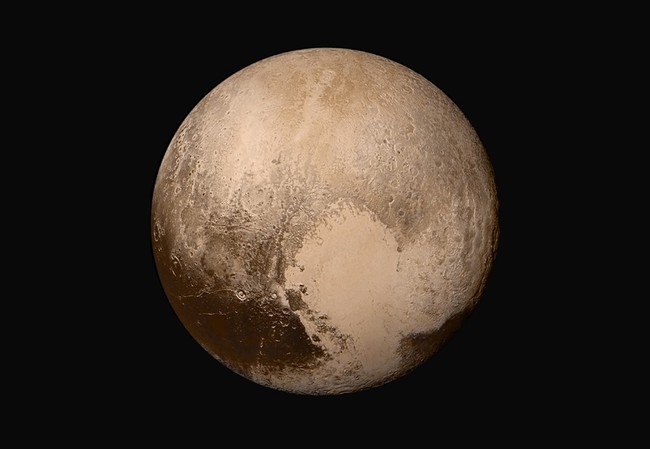
In 2006, the planet Pluto was “demoted” to a “dwarf planet” by the International Astronomical Union (IAU), the scientific authority responsible for naming and cataloging celestial objects. The number of planets in the solar system reverted to eight, and many people. including some scientists, weren’t happy. Tens of thousands of school children wrote letters to NASA begging the agency to restore Pluto to its rightful place in the cosmos.
Celebrity astronomer Neil deGrasse Tyson was one of the key players who convinced the IAU to change Pluto’s designation. Tyson’s Hayden Planetarium, which stopped calling Pluto a planet before anyone else, received thousands of letters, including some hate mail.
Tyson eventually published a book called The Pluto Files in 2009, which includes a collection of these letters. Many children wrote to say Pluto was their “favorite” or that it was “not fair” to kick it out of the “planet club.” Some even sent drawings of Pluto crying.
The issue never died. Now, NASA administrator Jared Isaacman is seeking to have the IAU reopen the case against Pluto. Isaacman responded to an X post from Mike’s Weather Page, who passed along a handwritten letter from ten-year-old Kaela. “Dear NASA, please make Pluto a planet again,” Kaela’s letter said. “I really want it to be a planet again!”
Dear @NASA. From 10 year old Kaela. She is mailing to you today. Too cute not to post. She and her family are friends of ours. #bringplutoback pic.twitter.com/goPIb55iQG
— Mike’s Weather Page (@tropicalupdate) April 9, 2026
The question is whether or not Pluto fits the definition of a planet as set down by the IAU.
In order for something to be determined as a planet, the IAU established three specific criteria:
- It must orbit a star.
- It must be big enough to have enough gravity to force it into a spherical shape.
- It must be big enough that its gravity has cleared away any other objects of a similar size near its orbit around the sun.
That last rule killed Pluto’s chances. Its orbit is strewn with objects, some the size of a snowball, others almost as large as Pluto itself. Under this new definition, the IAU excluded Pluto from our solar system’s family of planets.
But astronomers point out that that determination was made before the New Horizons spacecraft became the first probe to fly by Pluto in 2015. Ten years later, scientists are still trying to unpack all the data gathered in that short flyby.
What they’ve found so far is nothing short of incredible.
Scientists were shocked to find that Pluto is geologically active. The most famous feature is Tombaugh Regio, a giant heart-shaped glacier. Its western lobe, Sputnik Planitia, is a craterless plain of nitrogen ice estimated to be less than 10 million years old, suggesting constant resurfacing.
Massive mountains, some rising to 11,000 feet, were discovered. Because nitrogen ice is too soft to support such heights, researchers concluded these peaks are likely composed of a “bedrock” of water ice that stays rock-hard in Pluto’s extreme cold
The probe captured a stunning bluish halo around Pluto, revealing a complex, multi-layered atmosphere. All of this, and likely water-ice volcanoes, make Pluto one of the most geologically active bodies in the solar system.
To 10-year-old Kaela, Isaacman said: “We are looking into this.” His position also has continued support from former Administrator Jim Bridenstine.
But most of the IAU isn’t budging.
“We understand that many people feel Pluto was ‘demoted; but in fact, Pluto became the leading object of a new family of solar system bodies,” Ramasamy Venugopal, press and media coordinator for the International Astronomical Union, wrote in an emailed statement. “…Scientific classifications are determined through international consensus and evidence-based processes. While they are not subject to unilateral change, they can be amended if the supporting evidence changes.”
Some astronomers sounded annoyed that the issue of Pluto’s status as a planet may be revisited.
“While NASA administrators are free to wax nostalgic for the days when Pluto was a planet, the actual scientists working in the field will continue to try to explain and classify objects in the solar system in the way that actually helps us understand the world in which we live,” Mike Brown, a professor of planetary astronomy at the California Institute of Technology, told The Independent in an email.
Mr. Venugopal is absolutely correct – technically. But I would like to advance a different kind of argument, one that recognizes the role of ordinary people in science today.
NASA has a budget of $24 billion. But that’s just a drop in the bucket. The American taxpayer funds research into a wide variety of scientific disciplines. Despite significant funding cuts, the National Science Foundation and the National Institutes of Health continue to make extraordinary discoveries that benefit our health and impact our daily lives. The Department of Energy makes breakthroughs in physics. And, of course, NASA advances the cause of pure science more than any other agency.
All of this scientific research is funded by government money. The American people deserve to have a voice of some kind in scientific debates. Not the esoteric discussions about the science, but the debates over what to do with the discoveries. I believe the definition of a planet could be changed rather easily in light of the information that New Horizons relayed back to Earth. A planet that is geologically active, possesses an atmosphere, with a varied and, yes, beautiful surface, should impel the IAU to take another look at Pluto as a planet.
The universe belongs to all of us, not just scientists.
Editor’s Note: President Trump is leading America into the “Golden Age” as Democrats try desperately to stop it.
Help us continue to report on President Trump’s successes. Join PJ Media VIP and use promo code FIGHT to receive 60% off your membership.