
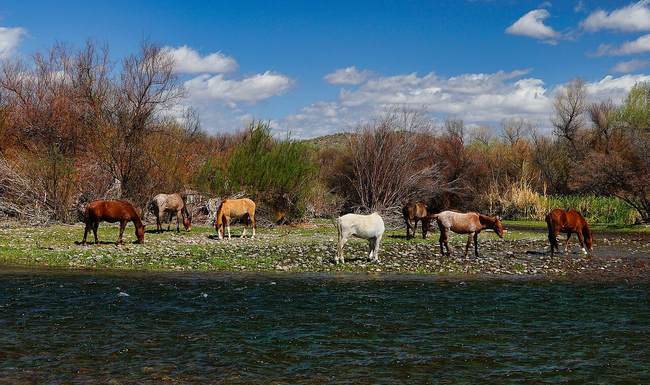
Controversy is again raging over the fate of the Salt River wild horses, protected under state law as a natural treasure, after the Arizona Department of Agriculture awarded a new management contract requiring the removal of more than half the herd — despite a state law that authorizes removals only for humane reasons related to the health and safety of individual horses.
It didn’t have to be this way. In 2016, Arizona Republicans did something Washington rarely manages to do. They solved a problem.
When the U.S. Forest Service moved to round up and remove every one of the Salt River wild horses from the Tonto National Forest, Arizonans responded with overwhelming opposition that stunned federal officials. More than 300,000 petition signatures flooded in. Members of Congress from both parties objected, including Sens. John McCain and Jeff Flake. Tonto National Forest spokeswoman Carrie Templin told reporters she had never seen anything like it: “We expected public outcry. I don’t think anybody comprehended the magnitude.”
The Republican-led Arizona Legislature acted. In 2016, lawmakers passed the Salt River Wild Horse Act by a 53-3 vote. It was signed into law by then-Gov. Doug Ducey, who counted it among his top accomplishments of the year. The law’s intent was unambiguous: to protect the herd from harassment, killing, and slaughter and limit removals to humane reasons only related to the safety or health of individual horses or public safety. Nothing in the bill authorized mass removals for population reduction. Then-State Senator Katie Hobbs was among those who voted for it.
What followed was a model of conservative governance. The Arizona Department of Agriculture, led by then director Mark Killian — a prominent Republican and former state senator, partnered with the nonprofit Salt River Wild Horse Management Group. This unique public-private partnership evolved into a unique and highly successful humane management program to protect the cherished herd.
Over the last seven years, the group implemented a fertility control program that has reduced annual births from more than 100 foals to just one or two. Over seven years, the herd declined from 450 horses to 274 — a 40% reduction — without removing a single horse except those injured or ailing animals in need of special care.
This program is privately funded at no cost to taxpayers, volunteer-powered, and state-overseen. A shining example of conservative principles: Limited government, local control, fiscal responsibility, and a private initiative solving a public problem.
And it’s working.
The herd is healthy. The population is declining gradually and responsibly. The horses occupy less than 1% of the Tonto National Forest, where they draw visitors from across the country. There is no emergency, no peer-reviewed science justifying drastic intervention, no public mandate for what is now being proposed.
And yet, the Arizona Department of Agriculture put the management contract up for bid last year with a requirement that all bidders include removals as part of a management plan. The pressure to remove the horses is coming from a federal bureaucrat — now Acting Supervisor of the Tonto National Forest — who oversaw the aggressive wild horse roundups from the Apache-Sitgreaves National Forest, resulting in Arizona wild horses being shipped to slaughter auctions in Texas.
Documents obtained through public records requests show that the Forest Service is pushing state officials to reduce the Salt River herd to as few as 21 horses — a number that would effectively eliminate it.
This is precisely the federal overreach the 2016 law was intended to block.
The Salt River Wild Horse Management Group ultimately retained the management contract — the right outcome. But they were forced to accept terms requiring the removal of horses. The new management plan calls for the removal of approximately 25 horses per year for five years, slashing the herd from 274 to 120. They agreed because the alternative was handing the horses to the contractor who ran the Apache-Sitgreaves roundups. It was a forced compromise, not a policy choice.
Rep. Kelly Townsend, who sponsored the 2016 bill protecting the horses, was direct: “I don’t think that is the will of the people. I would hope someone steps up and makes sure this law is enforced.”
Gov. Katie Hobbs has a choice. She can direct her Department of Agriculture to revise the contract, eliminate quota-driven removal requirements, and honor the law she once voted for.
In 2015 and 2016, Arizonans spoke clearly and across party lines. They demanded protection for the Salt River wild horses and got it.
They should not have to demand it again.
Enjoying PJ Media?
Get exclusive content and support independent journalism with 60% off a PJ Media VIP membership. Use promo code FIGHT and join today.