
Republicans are beginning to sound the alarm about the 2026 midterm elections, and not without reason. The concern was crystallized by a Texas state Senate race in a district President Donald Trump carried by 17 points in 2024 but which recently shifted 14 points toward Democrats — a staggering 31-point swing.
That race is not an anomaly. Republicans closely tracking special elections from Texas to Mississippi to Georgia are seeing the same troubling pattern: deep-red districts drifting, sometimes sharply, toward Democrats. These are not battlegrounds. They are places Republicans typically take for granted.
The warning signs extend beyond individual races. Betting markets currently give Republicans a 63% chance of retaining control of the Senate, compared with 37% for Democrats. That may sound reassuring, but it represents the weakest outlook Republicans have faced this cycle. The numbers are converging, and Democratic optimism is rising accordingly.
The House picture is even bleaker. Markets suggest a 78% chance Democrats will win the House, with just 22% betting on Republicans holding the majority.
Polling data reinforces the concern. A recent Harvard-Harris survey shows Democrats ahead by four points on the generic congressional ballot — a historically bad position for Republicans at this stage. In the Senate, several GOP seats are vulnerable. In Maine, betting markets now list Susan Collins as the underdog. In North Carolina, the open seat being vacated by Thom Tillis appears to lean Democratic. In Ohio, Sherrod Brown could plausibly pull off another victory.
Add those together and Democrats can plausibly reach 50 Senate seats before even stretching into traditionally Republican territory. Alaska, Iowa and even Texas — long-shot targets in normal years — could come into play if conditions worsen.
So what, if anything, can Republicans do to reverse course?
There is some mildly encouraging news buried in the same Harvard-Harris poll. It reveals a striking disconnect between economic reality and public perception. Fifty-six percent of Americans believe the economy is shrinking. It is not. Sixty-six percent think inflation is above 3%. It is not. Only 38% believe the economy is on the right track, even as Americans split roughly 50-50 on whether the economy is strong or weak.
That gap is political opportunity — but only if Republicans address it. The administration has failed to effectively communicate economic fundamentals, allowing misinformation and anxiety to fill the void.
Compounding the problem are the administration’s least popular economic messages: tariffs and inflation. The two are closely linked in voters’ minds. Trump’s repeated public pressure on the Federal Reserve to lower interest rates fuels inflation concerns, while his frequent rhetoric around tariffs reminds businesses — and voters — of higher costs and uncertainty.
If the president simply stopped emphasizing tariffs so aggressively, or eased off the public campaign against the Fed, perceptions around inflation might improve. Messaging matters, especially when economic confidence is fragile.
But the larger political battle is unfolding elsewhere.
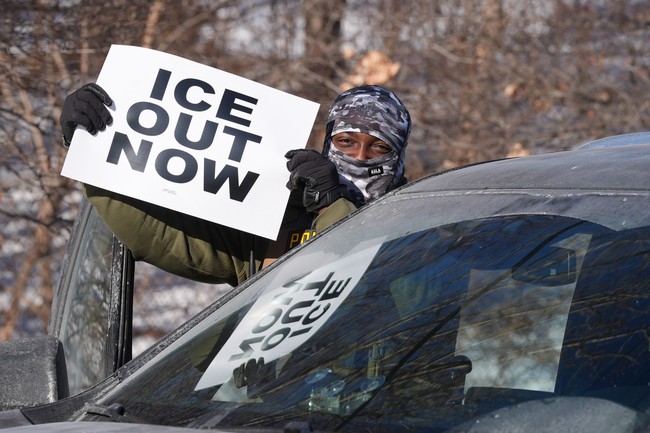
If you want to understand why Democrats are encouraging chaos in cities like Minneapolis, look no further than immigration. It is Trump’s strongest issue, and Democrats know it. Fifty-one percent of Americans approve of Trump’s response to anti-Immigration and Customs Enforcement protests. Forty-seven percent approve of his crime policies. Deporting criminal illegal immigrants is supported by 73% of Americans. Sixty-seven percent oppose sanctuary city policies. Sixty percent believe Democrats are encouraging resistance to ICE, and 57% oppose that behavior.
Americans are divided on whether enforcement should target only criminal illegal immigrants or extend more broadly. But the overwhelming consensus is clear: Targeting criminal illegal immigrants is popular. That is precisely why Democrats are attempting to blur the distinction — forcing ICE and Border Patrol into broader enforcement actions that can be portrayed as indiscriminate.
From a political standpoint, this is a trap Republicans must avoid. Trotting out administration officials to declare that everyone will be rounded up and deported from Home Depot may satisfy some activists, but it is terrible politics. Right or wrong, it alienates persuadable voters.
To its credit, the Trump administration has begun adjusting its approach. Border czar Tom Homan’s message to Minneapolis — “Give us your criminals” — is exactly right. From a public relations standpoint, targeting criminal illegal immigrants is an 80-20 issue, with Republicans firmly on the side of the 80.
Democrats are attempting to reframe immigration enforcement as tyranny, to convince Americans that indiscriminate crackdowns are imminent. The strategy is to escalate protests, inflame media coverage, and erode Trump’s standing on his strongest issue.
But this is not 2020. Attempts to recreate a “BLM summer” dynamic by demanding solidarity with criminal illegal immigrants are unlikely to resonate. The racial reckoning of 2020 carried emotional weight rooted in America’s history. The claim that criminal illegal immigrants are victims of systemic oppression does not.
Immigration remains Trump’s winning issue. If Republicans can discipline their messaging, close the information gap on the economy, and take control of the immigration narrative, the party still has a path forward.
If not, the warning signs flashing in special elections today may become the reality of November 2026.
Editor’s Note: Support and follow PJ Media’s coverage of immigration enforcement and other key news in this midterm election year. Join PJ Media VIP and use promo code FIGHT to get 60% off your membership.