
Welcome to “The New Monroe Doctrine,” where I give you an update on what’s going on in the Western Hemisphere, south of our border, especially as it relates to the United States.
I had something else planned to write about for this column today — specifically how some Latin American countries are handling mass migration much better than Europe — but Donald Trump released his new National Security Strategy in the last 24 hours, and upon reading it, I got a little giddy. Don’t judge. I love this stuff.
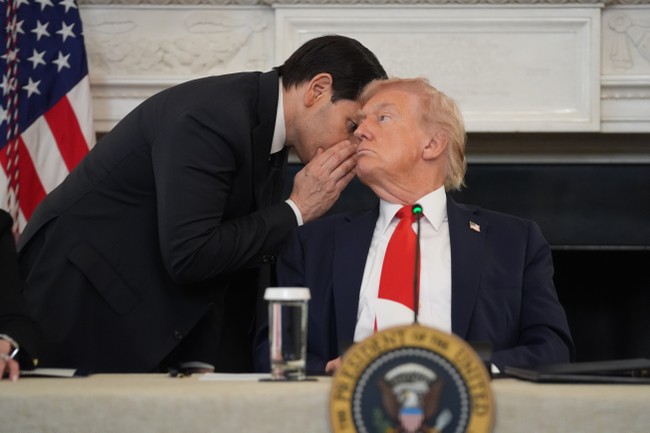
But what I love even more is what’s in it: tough on Europe, shifting away from the Middle East being the core of our foreign policy, fighting China economically, and focusing heavily on our own backyard, the Western Hemisphere. That’s literally the mindset that inspired this column when I started it a couple of months ago, and it’s one reason why I write about Latin America and the Caribbean so much. Our country has overlooked the importance of the Americas for too long, and now we have a president and a Secretary of State/National Security Advisor — because let’s face it, Marco Rubio is all over this — who understand that.
And there’s no better time like the present. As I’ve covered in great detail, many countries in the hemisphere are taking a broad swing away from socialism and toward common sense. They’re tired of crime, cartels, commie leaders, crumbling economies, China walking all over them, mass migration, and government corruption. They see partnerships with the United States as a way to get ahead instead of falling into Chinese debt traps. They’re electing their Javier Mileis and the Nayib Bukeles.
Related for VIPs: Something Is Changing in Latin America
We need to seize on this pivotal moment in history and champion it. I want to hear less about the war in Ukraine or how you can’t post memes in England without receiving a jail sentence and more about the amazing things the newly elected President Rodrigo Paz is doing in Bolivia or how Peru is already strengthening its border with Chile because it’s looks like that country will have a Trump-like president very soon who doesn’t put up with stuff like mass migration or how Ecuador is cracking down on crime or how Mexican people are rising up and protesting the cartels that are taking over their country, etc.
Anyway, I’m off on a tangent. Let’s get to the facts.
“In everything we do, we are putting America first.” That’s what the president writes in the introduction letter to his National Security Strategy before laying out what that means, where our country went astray, and what the United States wants and needs, including what it wants from the world. That includes literally building on the original Monroe Doctrine:
We want to ensure that the Western Hemisphere remains reasonably stable and well-governed enough to prevent and discourage mass migration to the United States; we want a Hemisphere whose governments cooperate with us against narco-terrorists, cartels, and other transnational criminal organizations; we want a Hemisphere that remains free of hostile foreign incursion or ownership of key assets, and that supports critical supply chains; and we want to ensure our continued access to key strategic locations. In other words, we will assert and enforce a ‘Trump Corollary’ to the Monroe Doctrine
For this column, I’m going to skip most of the document (you can read it in full here: National Security Strategy) and review the final section, which focuses on various regions around the world. I think it’s something many of you will like based on the comments and emails I receive (emphasis mine): “To focus and prioritize is to choose — to acknowledge that not everything matters equally, to everyone. It is not to assert that any peoples, regions, or countries are somehow intrinsically unimportant. The United States is by every measure the most generous nation in history—yet we cannot afford to be equally attentive to every region and every problem in the world.”
The first regional section focuses on the Western Hemisphere and begins (again, emphasis mine):
After years of neglect, the United States will reassert and enforce the Monroe Doctrine to restore American preeminence in the Western Hemisphere, and to protect our homeland and our access to key geographies throughout the region. We will deny non-Hemispheric competitors the ability to position forces or other threatening capabilities, or to own or control strategically vital assets, in our Hemisphere. This ‘Trump Corollary’ to the Monroe Doctrine is a common-sense and potent restoration of American power and priorities, consistent with American security interests. Our goals for the Western Hemisphere can be summarized as ‘Enlist and Expand.’ We will enlist established friends in the Hemisphere to control migration, stop drug flows, and strengthen stability and security on land and sea. We will expand by cultivating and strengthening new partners while bolstering our own nation’s appeal as the Hemisphere’s economic and security partner of choice.
It goes on to say that the United States will focus on encouraging regional governments, parties, and movements to partner with us; we’ll readjust our global military presence to focus on cleaning up the Western Hemisphere and maintaining a strategic presence; and we’ll prioritize commercial diplomacy that strengthens both our economies and the domestic economies of our regional partners.
It also focuses on how “non-hemispheric competitors” (aka mostly China) have “made major inroads into our hemisphere, both to disadvantage us economically in the present, and in ways that may harm us strategically in the future” and that “allowing these incursions without serious pushback is another great American strategic mistake of recent decades.”
So, what are we going to do about it? This part’s lengthy, but it’s good. (And it’s exactly the way to combat the stuff I’ve been writing about in my weekly “China in the Americas” column, which I bring up only to apologize for not getting one out this week — I was still recovering from Thanksgiving and ear and sinus issues, and those things can be beasts to research and write).
The United States must be preeminent in the Western Hemisphere as a condition of our security and prosperity — a condition that allows us to assert ourselves confidently where and when we need to in the region. The terms of our alliances, and the terms upon which we provide any kind of aid, must be contingent on winding down adversarial outside influence — from control of military installations, ports, and key infrastructure to the purchase of strategic assets broadly defined.
Some foreign influence will be hard to reverse, given the political alignments between certain Latin American governments and certain foreign actors. However, many governments are not ideologically aligned with foreign powers but are instead attracted to doing business with them for other reasons, including low costs, and fewer regulatory hurdles. The United States has achieved success in rolling back outside influence in the Western Hemisphere by demonstrating, with specificity, how many hidden costs — in espionage, cybersecurity, debt-traps, and other ways — are embedded in allegedly ‘low cost’ foreign assistance. We should accelerate these efforts, including by utilizing U.S. leverage in finance and technology to induce countries to reject such assistance.
In the Western Hemisphere — and everywhere in the world—the United States should make clear that American goods, services, and technologies are a far better buy in the long run, because they are higher quality and do not come with the same kind of strings as other countries’ assistance. That said, we will reform our own system to expedite approvals and licensing — again, to make ourselves the partner of first choice. The choice all countries should face is whether they want to live in an American-led world of sovereign countries and free economies or in a parallel one in which they are influenced by countries on the other side of the world.
Every U.S. official working in or on the region must be up to speed on the full picture of detrimental outside influence while simultaneously applying pressure and offering incentives to partner countries to protect our Hemisphere.
Successfully protecting our Hemisphere also requires closer collaboration between the U.S. Government and the American private sector. All our embassies must be aware of major business opportunities in their country, especially major government contracts. Every U.S. Government official that interacts with these countries should understand that part of their job is to help American companies compete and succeed.
I’ll stop there because it’s Friday evening, and no one wants to read a million walls of text, but I can’t applaud this hard enough. We’re already seeing it in action, but I want to see more, and I can’t wait to witness what the next three years bring. The strength we could gain from these alliances can offer immeasurable benefits.
And on that note, here are a few other updates from the Hemisphere.
1. Honduras still doesn’t have a president, but the conservative Nasry Asfura (Trump’s pick) and the more centrist guy Salvador Nasralla are still running neck and neck. The only way the commie Rixi Moncada wins is through something fraudulent, which was probably the plan, but there are too many eyes on the Central American nation now, especially those of U.S. and OAS officials. I believe the National Electoral Council has until the end of December to certify the results.
2. Venezuela still doesn’t have its rightful president, Edmundo González, either, but the buffoon holding the nation hostage is still acting like a clown. He’s been singing and dancing for weeks and bragging about how famous he is in the United States. Our president has a lot more restraint than I do, because if I had to see this man dancing to this song made up of his own broken English again, and I had the capability, I’d just drop a bomb on him to shut him up. Here’s his latest performance.
Maduro is very happy and laughing about Trump’s threats on national television. It would be a shame if this post got thousands of retweets, millions of views, and President @realDonaldTrump ended up seeing it. pic.twitter.com/Qm2LTtnsne
— Emmanuel Rincón (@EmmaRincon) December 5, 2025
3. Meanwhile, here’s something the MSM isn’t covering. One of Maduro’s former officials is currently in U.S. custody, awaiting sentencing on narco-terrorism charges. In exchange for a lighter sentence, he’s telling what he knows. This week, he wrote a letter to Trump, and it basically confirms that Maduro, and Hugo Chávez before him, waged war on the United States long ago: Maduro’s Ex-Insider Turns Snitch, Sends Trump an Explosive Letter.
4. In Costa Rica, a country that I suspect will benefit greatly from our new National Security Strategy, they just intercepted 4.4 tons of cocaine out of Colombia, one of the largest drug busts of the year: Guess What Turned Up in Costa Rica This Week? (Hint: Petro Probably Most Hurt).
5. On Thursday, Rubio called on other countries in Latin America and the Caribbean to step and help with stabilization in Haiti. I’m going to try to write more about that next week.
6. And here’s something else the MSM doesn’t seem to want to cover. Cuba is facing a major humanitarian crisis, which includes three concurrent epidemics. Disease has impacted at least a third of the country. And it’s doing so amidst food shortages and power outages that last 12-24 hours, including the most recent that impacted half of the country. I lay out all the details here: Death In the Street: Aside From the Obvious, There’s a Big Problem In Cuba.
Well, that’s it for me. As I say, Rubio isn’t handing me exclusives… yet, but he and President Trump did hand all of us a nice little national security plan that will make me sleep a little better tonight anyway.
And on that note, I’m off to prepare for tomorrow’s SEC Championship. Go Dawgs! Y’all have a good weekend.
Help us report the stories the MSM won’t tell you by becoming a PJ Media VIP member. Right now, memberships are 60% off or less than $20 for the entire year. In addition to supporting us, you gain access to exclusive stories and podcasts, the comments section where you can interact with our team and other readers, an ad-free experience, and much more. Click here to get started. We can’t wait to have you.