
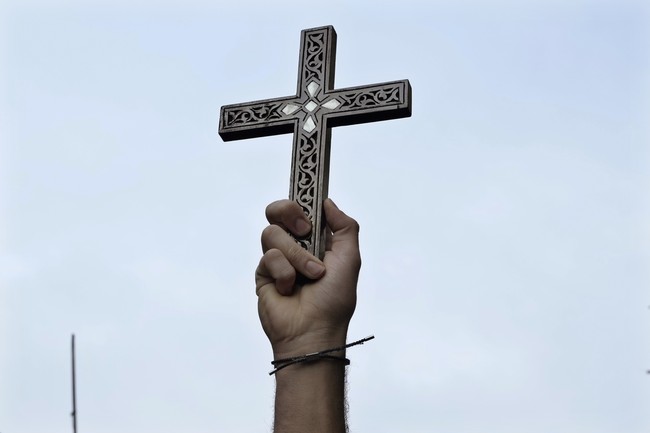
The process of Syria’s radical Islamization and the vulnerability of Christians is ongoing at full speed. Jihadist indoctrination now starts at a very early age, including at kindergartens. Six-year-old girls at “Dar Al-Wahy” school in the city of Homs were recently recorded chanting during their morning assembly, “Welcome to death for the sake of Allah!”
The X account Greco-Levantines Worldwide reported on 17 February:
We are receiving almost daily videos of children marching in Damascus and chanting slogans widely recognized as jihadist — including phrases meaning, “I will make myself ammunition.” These chants are consistently directed at Christians and Jews.
Since the fall of the Assad regime in December 2024, jihadist Hay’at Tahrir al-Sham (HTS)-led forces have largely controlled Syria. This is an Islamic terrorist group with roots in Al-Qaeda and ISIS (Islamic State).
Syria has since seen a sharp increase in violence, including the murder of Christians and attacks on churches. Christians are often targeted for theft, extortion, and kidnapping.
Eli Najjar Taqla, a 21-year-old Antiochian Greek Christian from Muhardeh, was shot on 1 February. His murder has deepened fears among Syria’s Christian communities. His death is not seen as an isolated incident, but rather as part of growing concerns over insecurity and the spread of weapons in the country.
Bashar Elias, an Antiochian Greek from Ma’rouneh, was kidnapped on 4 February in front of his family. His brother and sister were beaten when they tried to defend him. His fate remains unknown.
Social pressure and the rise of jihad significantly restrict the freedom of Christians in education, clothing choices, social interactions, and worship. On 1 February, before Sunday Mass, a young man carrying a Quran entered the Melkite Greek Cathedral of Al Zaitoun (the Patriarchate headquarters). He chanted “Allahu Akbar” and recited Quranic verses. Such abuses are persistent because they are now protected by both the country’s new regime and constitution.
The new interim constitution, proclaimed in March 2025, stipulates that Islamic law is the primary source of legislation. It further lacks sufficient protection for minorities.
At the same time, attacks against other religious minorities by the HTS regime and affiliated militias in March and July 2025 primarily affected Alawites and Druze, although Christians also suffered casualties. Hundreds of Alawite and Druze women were abducted and sexually assaulted. Some Alawite women were taken as sex slaves.
Meanwhile, Syrian education is being reformed according to Islamic teachings. These reforms are eliminating pre-Islamic history and gender equality and incorporating Quranic verses that negatively reference Jews and Christians, fostering hostility. It is obvious that this is an effort to Islamize education and redefine Syrian identity.
In October 2025, Syria held tightly controlled indirect parliamentary elections through regional electoral colleges, resulting in minimal minority representation. Only one Christian was elected.
Meanwhile, terrorist attacks against churches in the country are ongoing. On 18 December 2024, the Greek Orthodox Archdiocese in Hama was attacked by Islamic gunmen. Church property and religious symbols (crosses) were destroyed, a nearby Christian cemetery desecrated, and graves vandalized.
On 22 June 2025, a suicide attack on the Mar Elias Greek Orthodox Church in Damascus murdered 30 Christians during the church service, wounded 54, and caused severe damage to the historic church building.
The vulnerability of Christians in the country largely stems from their lack of political and military power today. However, Syria is a foundational cradle of Christianity, with roots stretching back to the first century. Its history notably features the conversion of St. Paul on the road to Damascus and the naming of followers of Jesus as “Christians” in the city of Antioch. Syria was a major center for early Christian theology, with diverse communities such as Greeks, Armenians, and Assyrians. Syrian Christianity preserved the use of Aramaic, the language of Jesus, with many ancient liturgies still in use today.
The Arab invasion of Eastern Roman (Greek Byzantine) Syria in the seventh century was a pivotal campaign by the Rashidun Caliphate that shattered Christian Byzantine control in the Levant. Keyed by victories like the Battle of Yarmouk in 636, the Arab jihadist forces invaded and captured major cities including Damascus and Jerusalem from Byzantine forces. They massacred many natives, raped women, and converted churches into mosques. As a result, the Levant, which was then majority-Christian, became part of the rapidly expanding Islamic caliphate, fundamentally changing the demographic and religious landscape of the region.
Since gaining independence from the French mandate in 1946, Syria has faced political instability, military coups, and conflict. The Assad family ruled the country for over 50 years, from 1970 until December 2024. The Assad regime fell when HTS-affiliated forces led by the former leader of Syrian al-Qaeda, Abu Mohammad al-Julani/Ahmed al-Sharaa, captured Damascus. Since the fall of Assad, Islamic oppression (already the leading cause of persecution) has intensified.
The greatest pressure against Christians in the country currently occurs in Damascus and Aleppo, where – despite the cities’ historic Christian presence – growing hostility from Muslim communities, the HTS-led regime, and other terrorist groups has fostered discrimination and danger. Other hard-hit areas include the city of Idlib and some northern zones under Turkish influence and occupation, as well as ISIS cells, where displacement and human rights abuses prevail.
In central Syria, such as Homs and the Wadi al-Nasara (the Valley of Christians) area, persecution is also severe. On 24 February, Iman Georges, a Christian teacher and mother from Homs, was shot and murdered by a Muslim man.
Syria ranks 6th in the World Watch List of Open Doors that monitors global Christian persecution. According to Open Doors’ latest summary report on Syria:
Christians face conversion pressure, attacks on churches, social pressure to wear headscarves, the removal of Christian symbols, and verbal intimidation. Religious and political freedoms are being curtailed through repression, surveillance, control of churches, and the arrest of critical activists to maintain absolute authority.
Historical Christian communities—with the Orthodox as the largest, followed by Melkite Catholics—face increasing pressure from both the current regime and extremist groups. Challenges include bureaucratic delays affecting activities or renovations, constant surveillance, and targeted threats against religious leaders and churches. Churches are subjected to insults, bombings, and intimidation, including leaflets demanding conversion or jizya.
Baptist, Evangelical, and Pentecostal congregations face significant pressure due to limited legal recognition, perceived Western orientation, evangelistic activities among Muslims, and admitting Muslim converts, making them vulnerable to closure, surveillance, and restrictions.
Women from religious minority groups, including Christians, risk abduction, sexual harassment, and rape by radical groups and individuals. Field sources report that threats, attempted (sexual) assaults, and the fear of abduction persist, particularly during clashes and in unstable areas. A country expert noted that ‘there are hardly any safe spaces for women and girls,’ highlighting their exposure to sexual violence at checkpoints, workplaces, and on public transportation. Cultural stigmas and the fear of reprisals deter victims from reporting assaults.
Despite all these, both the U.S. government and the European Council decided to lift the economic sanctions on Syria in 2025. Eiad Herera, spokesperson of the Antiochian Greek Organization, told PJ Media:
Violence presented as isolated incidents, as the Syrian authorities claim, is simply another face of massacres and of the policy of displacement and intimidation pursued to impose a religious identity and carry out social engineering based on a single, exclusionary identity.
There must be clear and strict mechanisms to ensure the enforcement of the conditions for the lifting of sanctions. Christians and other minorities are very vulnerable now: unarmed, no media, no Western support. They are literally left at the mercy of Julani and his Al Qaeda militias.
Support independent journalism that doesn’t flinch when faith enters the conversation. Join PJ Media VIP today and get 60% off with promo code FIGHT.