
Since Pakistan’s 1947 creation, its military has demonstrated massive influence over the government, the judiciary and the media, curtailing the powers of civilian politicians. Pakistan’s military establishment has always played an active role in the political administration, including suppressing the country’s opposition.
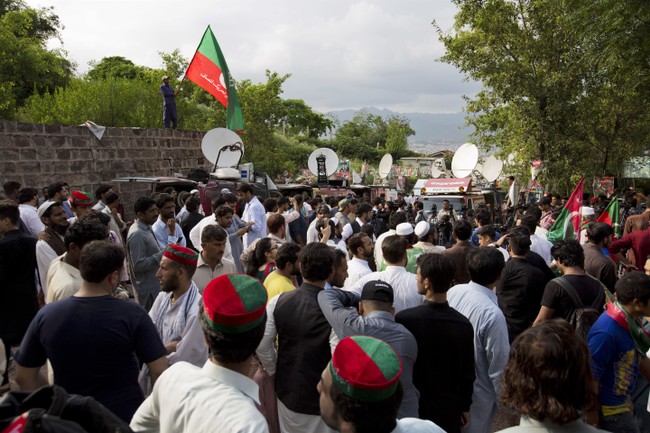
In 2024, national elections were held after a concerted campaign by the military establishment to weaken former Prime Minister Imran Khan and his Pakistan Tehreek-e-Insaf Party (PTI). This attempt led to Khan’s imprisonment and his party was prevented from fielding official candidates.
Khan served as Pakistan’s prime minister from 2018 until April 2022, when he was removed in a no-confidence vote. He was imprisoned in August 2023 on various charges of corruption and for revealing state secrets.
During the final months of his premiership and subsequently as opposition leader, Khan was publicly critical of the military. The breakdown in relations between Khan and the military was seen as the key factor in his ouster. Khan, and his wife, Bushra Bibi, have been sentenced to 17 years in prison after a Pakistani court found them guilty of illegally retaining and selling valuable state gifts.
The UN special sapporteur on torture, Alice Jill Edwards, said in December 2025 that “inhumane and undignified detention conditions of former Prime Minister Imran Khan could amount to torture and other inhuman or degrading treatment.”
In its latest report, Freedom House described Pakistan’s military establishment as follows:
The military exerts enormous influence over the conduct of elections, government formation, and policies; intimidates the media; and enjoys impunity for indiscriminate or extralegal use of force.
The military is deeply opaque in its affairs. Military intelligence agencies act without oversight and often without public knowledge, including when they abduct, detain, interrogate, and torture individuals. Vaguely worded regulations empower military officials to monitor and censor media content that is deemed harmful to national security.
The military has long been considered more powerful than elected politicians and able to influence electoral outcomes.
By restricting the PTI’s (Pakistan Tehreek-e-Insaf Party’s) ability to participate in the February 2024 elections, the military achieved its objective of excluding the party from national power and installing a more pliant national administration.
Although Sindhi, Pashtun, and Baloch figures all play visible roles in national political life—alongside the largest ethno-linguistic group, Punjabis—the military works to marginalize figures from minority groups that it suspects of harboring anti-state sentiments.
With the civilian administration increasingly dependent on the military for survival, the army has expanded the areas of policymaking which it influences beyond national security and foreign policy to include economics, immigration, and media control.
Yet there were still long-running power struggles between the military, the civilian government, and opposition politicians for control of national security policy.
In November 2025, the military supremacy in the country was institutionalized through the 27th amendment to Pakistan’s constitution. This has further eroded the civilian government.
The amendment’s passage had strong support from the ruling coalition. It demonstrates the civilian government’s dependence on the military establishment, further blurring the distinction between civil and military authority in the country.
“The 27th amendment to the Constitution of Pakistan is a flagrant attack on the independence of the judiciary and the rule of law,” said the International Commission of Jurists (ICJ).
“The changes made to the judicial system in the 27th amendment are alarming,” said Santiago Canton, ICJ’s secretary-general. “They will significantly impair the judiciary’s ability to hold the executive accountable and protect the fundamental human rights of the people of Pakistan.”
Together with the 26th amendment, passed in October 2024, the amendment fundamentally alters the judiciary’s structure and undermines its function in various ways.
The ICJ said that it is particularly concerned about the changes introduced by the 27th amendment regarding the establishment of a Federal Constitutional Court (FCC), the appointment of the chief justice of the FCC and the first batch of judges to the FCC, the appointment of the Chief Justice of the Supreme Court and the Federal Constitutional Court, the composition of the Judicial Commission of Pakistan, and the transfer of judges of High Courts as well as immunities. The ICJ noted:
The 27th Amendment changes Article 248 of the Constitution of Pakistan to grant the President of Pakistan lifetime immunity from criminal proceedings and arrest, as well as protections against civil proceedings. It provides this immunity will not apply for the duration the President holds a public office after they cease to be the President. Earlier, the President only had such immunity for the time they were in office.
In addition, amendments to Article 243 of the Constitution grant lifelong immunity from criminal proceedings and arrest, as well as protections against civil proceedings to the “honorary” ranks of the Field Marshal, Admiral of the Fleet, and Marshal of the Air Force. Currently, the Chief of the Armed Forces also has the rank of Field Marshal.
Such sweeping and unconditional immunities are contrary to core rule of law principles including accountability, access to justice, and equality before the law. No public official should ever be entirely unaccountable, as this effectively allows for the possibility of unlawful or arbitrary exercise of power without consequence.
The ICJ raises serious concern about the grave consequences of the ongoing dismantling of the rule of law and the resulting violations of human rights in Pakistan and calls upon all responsible executive and judicial officials to only give effect to the amendments in a manner that is compliant with the rule of law.
Pakistan scores poorly in corruption indexes (129 out of 142 in the Rule of Law Index of the World Justice Project, 2024) across all social sectors. The military establishment is a massive part of the corruption. According to the Freedom House,
Despite numerous formal safeguards, official corruption is endemic in practice. The use of accountability mechanisms is often selective and politically driven. The National Accountability Bureau (NAB), the government’s anticorruption body, focuses on cases against politicians and senior officials, which tend to be protracted. The military and judiciary have their own disciplinary systems for corruption.
Direct or implied criticism of the military and its perspectives on national security often draws criminal or extrajudicial punishment, including enforced disappearances in the country.
Journalists who are deemed to have antagonized the military through their reporting are subject to enforced disappearance and other abuses. Prominent journalist Matiullah Jan, along with a colleague, was detained in Pakistan’s capital Islamabad by plainclothes operatives during November 2024 PTI protests. The journalists were released after three days. They were booked on terrorism and narcotics charges, which are widely understood to be a cover for security agency harassment. Enforced disappearances of journalists are most frequent in Balochistan, such as in the case of Zubair Baloch, who disappeared from Hub in December 2024.
The trial of civilians in military courts under the Army Act is already a highly controversial issue. All 85 civilian PTI supporters tried by military courts for their role in May 2023 riots were found guilty and sentenced to 10 years in prison.
Meanwhile in November 2024, the Human Rights Commission of Pakistan (HRCP) marked the fifth anniversary of the jailing of human rights activist Idris Khattak, who was convicted of fabricated charges by a secret military court.
Following the bill’s passage, the military is expected to further curtail media freedom, as well as the citizens’ right to a fair trial and their rights of appeal. It will also likely escalate Pakistan’s military conflicts with its neighboring nations, particularly India and Afghanistan, as well as with its own oppressed minorities, as decisions by the state will now exclusively be dominated by military logic. Pakistan’s formalization of its military’s patronage leaves minimal space for diplomacy or political negotiation.
Pakistan’s 27th Constitutional Amendment Bill marks a decisive transformation in the country’s power structure, formally entrenching the military’s dominance within the constitutional framework,” writes Ajit Kumar Singh.
The amendment establishes the Chief of Defense Forces (CDF), unifying command over the Army, Navy, and Air Force, while abolishing the Chairman, Joint Chiefs of Staff Committee…
At the center of this transformation stands the Army Chief, Field Marshal Asim Munir, set to become the first CDF. By amending Article 243, the legislation grants him lifelong privileges, retention of rank, and immunity comparable to that of the President.
Consolidating operational command, strategic oversight, and control over nuclear and intelligence assets in a single office, the amendment cements the Army Chief’s primacy within the state apparatus…
Critics… warn that the amendment is a calculated move to formalize the military’s political dominance under a constitutional veneer. Opposition parties, lawyers’ bodies, and civil society groups have condemned it as ‘person-specific,’ designed to perpetuate General Munir’s authority and shield the establishment from judicial or parliamentary scrutiny.
The creation of a Federal Constitutional Court, empowered to interpret constitutional disputes, has been criticized for undermining the Supreme Court’s authority and independence.
The reform thus completes Pakistan’s transition from a hybrid regime to one where the military’s dominance is constitutionally enshrined and self-perpetuating.
Pakistan’s volatile politics, weak civilian governance, authoritarian military dominance, systematic corruption, rampant organized crime and widespread human rights abuses are very likely to become even more persistent now that the military’s supremacy has been effectively institutionalized in the country.
Right now, we’re offering a VIP membership exclusive deal — get 60% off your membership when you use the promo code FIGHT at sign-up. Explore our membership levels and benefits by clicking here. Your support makes our work possible!