
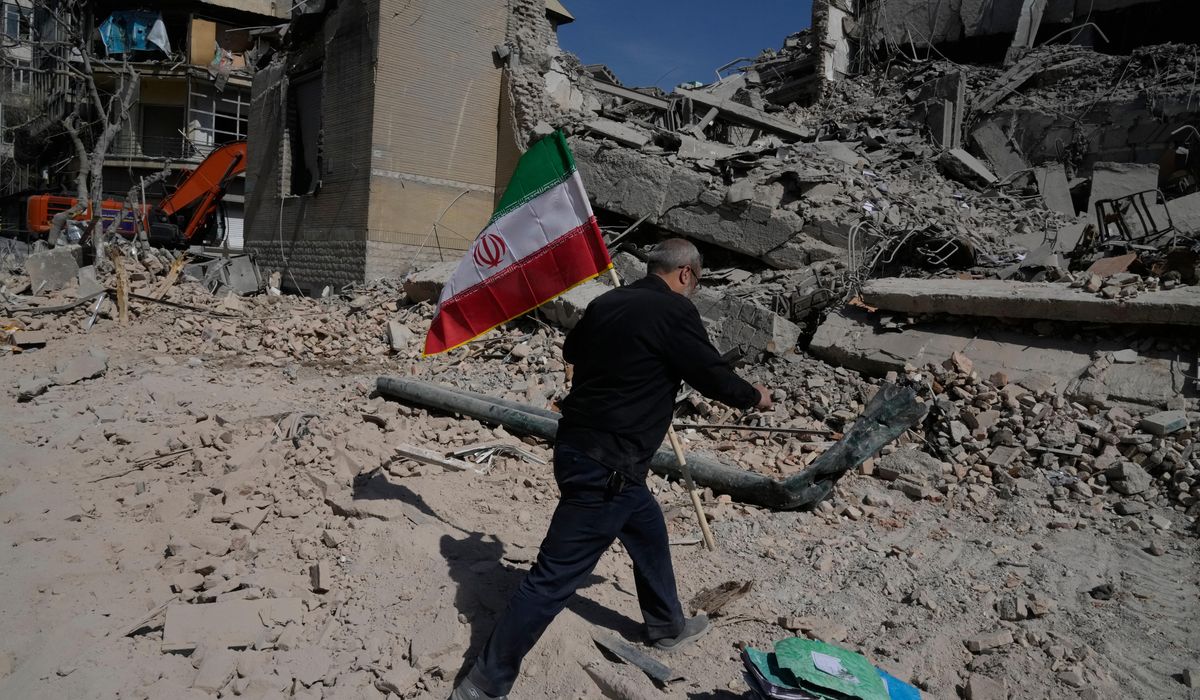
MUMBAI — Four days of Iranian missile and drone strikes on Gulf cities have turned what Washington described as a limited decapitation campaign into a widening stress test of the region’s energy corridors, aviation networks and political alliances — from the Strait of Hormuz to India’s financial markets and Pakistan’s streets.
The White House originally framed Saturday’s strikes on Iran as decisive and contained. But by Monday, consequences had moved beyond Iranian command targets and into the infrastructure that links the Gulf to South Asia.
An unmanned vessel struck a Marshall Islands–flagged tanker off the coast of Oman, killing one crew member. Saudi authorities said Iranian drones targeted the Ras Tanura refinery near Dammam, one of the kingdom’s most important oil processing facilities. Officials shut the refinery as a precaution.
Brent crude rose roughly 9% Monday morning, crossing $79 a barrel and topping $80 two days later.
For India, the exposure to rising costs of oil from the Gulf is structural. Roughly half of its crude imports, about 2.6 million barrels per day, move through the Strait of Hormuz. About 60% of its liquefied natural gas follows the same route. India imports 88% of its crude overall.
India’s civil aviation ministry said carriers canceled more than 850 Gulf-bound flights over two days after Dubai International Airport and Hamad International Airport suspended operations. The India–UAE corridor ranks as the fifth busiest in global aviation, linking Dubai to 23 Indian cities with more than 500 weekly flights. Nearly 12 million passengers traveled between the two countries last year.
Those links are not abstract. Nearly 9 million Indian nationals live and work across the Gulf. They account for roughly 40% of India’s inward remittances, according to the Reserve Bank of India. Any prolonged slowdown in Gulf economies will transmit directly into Indian household income, especially in Kerala and Punjab.
India’s External Affairs Minister S. Jaishankar spoke with Gulf counterparts over the weekend. Officials said India’s refineries hold enough crude to cover roughly 10 to 15 days of demand, with strategic reserves extending the buffer further. Replacement shipments from the Atlantic Basin would take weeks, not days.
As the U.S.-Israeli war on Iran has intensified, Middle Eastern governments have sought to project control, but Anwar Gargash, diplomatic adviser to UAE President Sheikh Mohamed bin Zayed, told The National that Gulf states had privately pushed for de-escalation.
“We did not support the choice of war,” he said. He added that Iran’s retaliatory strikes breached a tacit understanding. “The UAE will not sit cross-armed in the face of Iran’s attacks and will review its options.”
Wolfgang Pusztai, senior adviser at the Austrian Institute for European and Security Policy in Vienna, said Iran’s strategy appears designed to shift pressure onto Gulf governments and their oil buyers.
“By closing the Strait of Hormuz and possibly also targeting oil and gas infrastructure, Iran obviously wants to put so much pressure on the affected countries in the region and their buyers that they in turn will pressure the U.S. president to end the war,” he said.
He warned that escalation against Gulf energy facilities could alter the political geometry of the conflict.
“While missile strikes on Gulf energy infrastructure would certainly increase this pressure on the Gulf states significantly, this would almost certainly also drag the Arab states directly into the war, which is not in the interest of Tehran.”
He also pointed to fragmentation within Iran’s military command.
“One problem with some of the strikes that have already occurred is that the Iranian chain of command is essentially broken, allowing local commanders to select their own targets. This may not align with the intentions of the leadership in Tehran.”
The countries most exposed to prolonged disruption, he said, include the Gulf states themselves as well as major importers of Gulf energy — China, India and Europe.
“A key question is how resilient they will be if the supply from the Gulf is interrupted for a longer period of time,” he said.
Duration may determine whether the confrontation remains limited.
“Based on solid intelligence about the situation in Iran, the U.S.-Israeli plan probably expects the regime to crumble in about a week,” he said. “The size of air defense missile stocks in the Gulf states, the U.S., and Israel was certainly a limiting factor for planning. If the planners had expected a protracted war, Trump would not have given his approval.”
Reopening the Strait of Hormuz by force would require “a major amphibious operation on the Iranian side,” he said, adding that such a move would mean direct entry into the war. He said he does not expect Europe, China or India to mount such a mission.
Paul Musgrave, associate professor of government at Georgetown University in Qatar, spoke to The Washington Timesfrom Education City, roughly 20 miles from Al Udeid Air Base, the largest American military installation in the Middle East.
“If Iranian retaliation had been strictly limited to U.S. assets and Israel, the response might have been different,” he said. “But the response has been so aggressive, and has involved so many civilian properties, even indirectly, that many in the Gulf now see Iran as a direct threat.”
He said sustained economic coercion is more likely to harden Gulf states against Tehran than fracture U.S. partnerships.
Adelle Nazarian, a senior fellow at the Gold Institute for International Strategy in Washington, said the leadership decapitation in Tehran has accelerated strategic recalibration across the region.
“The regime’s coercive apparatus has been disrupted at its apex,” she said. “Strategic alignment may solidify around pragmatic priorities: energy security, maritime protection and discreet defense coordination along the India-Gulf-Israel axis.”
Dr. Damyana Bakardzhieva, senior research fellow at the Anwar Gargash Diplomatic Academy in Abu Dhabi, said the attacks exposed limits in Gulf deterrence mechanisms.
“The attacks have demonstrated that the deterrence mechanisms of any of the Gulf countries are insufficient and that there is a need for a structural change in the Gulf security infrastructure,” she said.
She cited the January signing of a UAE–India letter of intent for a bilateral Strategic Defence Partnership and the 2025 Saudi–Pakistan mutual defense cooperation agreement as evidence of diversification beyond traditional suppliers.
“In order to maintain its stabilizing economic role in the region and beyond, and its economic openness strategy, the UAE needs to operate in a secure regional environment,” she said.
The shockwaves reached Pakistan as well. Authorities deployed troops after unrest on Sunday near U.S. diplomatic facilities in Karachi ended with at least 10 protesters shot dead.
Samriddhi Vij, a Middle East analyst at the Observer Research Foundation in New Delhi, said the crisis has exposed the limits of interdependence as a stabilizing force.
“When survival becomes paramount, economic interdependence ceases to function as deterrent and instead becomes pressure point open to exploitation,” she said.