

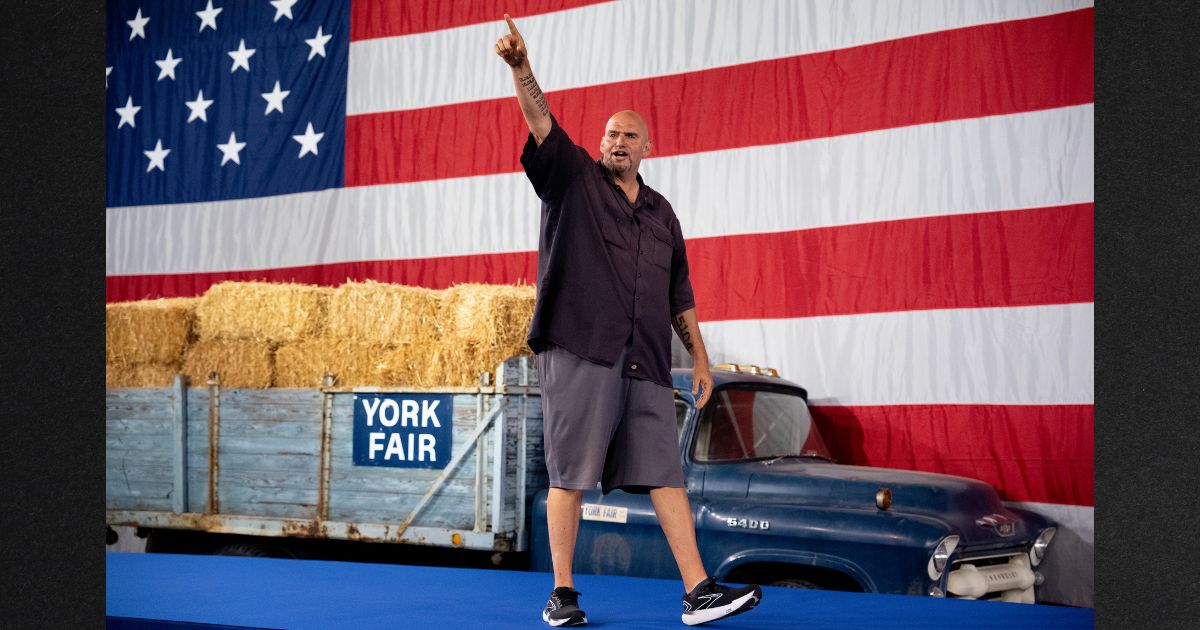
Dressed in a hoodie and oversized shorts, at first glance, John Fetterman resembles a construction boss for the White House ballroom more than a senator from the fifth-largest state in the nation.
However, his atypical lawmaker’s appearance demonstrates his authenticity and commitment to representing the people, rather than conforming to political norms.
But perhaps more importantly, as a voice of reason amid the increasingly contentious division between Democrats and Republicans, he is a profile in courage and living proof that a book is rarely determined by its cover.
Viewed by some as a traitor to his party, Fetterman has consistently voiced his willingness to work across party lines and calm the superheated rhetoric that has become commonplace between Democrats and Republicans.
Most recently, after Nancy Pelosi labeled President Trump a “vile creature” and “the worst thing on the face of the earth,” Fetterman responded that “I would never use those … terms [to] describe our president.” And “You can really disagree with him … but I don’t think that’s entirely appropriate.”
However, such demonization of political opposition has become increasingly common. Yet, while members of both parties criticize each other, the left undeniably dominates the stage in continually upping the negativity ante at the expense of constructive political discourse.
Almost daily, progressives brand Trump as a tyrant, a fascist, and, as America’s Hitler, his guilt by association, backers are little better. Hard to ignore, who could forget in 2008, Barack Obama claimed that many bitter people living in small towns in Pennsylvania and the Midwest, “cling to guns and religion or antipathy to people who are not like them or anti-immigrant sentiment … as a way to explain their frustrations.”
Not outdone by Obama, in 2016, Hillary Clinton said that half of Trump’s supporters are “irredeemable” and could fit into a “basket of deplorables.” And as recently as 2024, she doubled down on that judgment by maintaining her initially negative generalization for some of Trump’s supporters was “too kind” a description.
More recently, before the recent presidential election, Joe Biden called Trump supporters “garbage.” And this past June, Congresswoman Jasmine Crockett defiantly described the president’s followers as “sick” and support for him as a “mental health crisis.”
And though John Fetterman has repeatedly urged his party to cease such divisively counterproductive name-calling, his “very isolating” pleas are unsurprisingly met with progressive silence, when not met with demands for the same.
The first-term Pennsylvania senator has repeatedly stressed the importance of having constructive conversations with “the other side.” And to promote that goal, he vowed not to “compare anyone to Hitler. That’s wrong. And if you resort to that … you’ve lost the plot.”
Fetterman later reaffirmed those sentiments by saying, “I refuse to call members of the other team fascists or Nazis … because if you do, then that implies … the people that vote for them must be the same … and that is absolutely not true.”
Fetterman describes himself as a “very honest Democrat that’s not afraid to push back against some of those views that I just don’t agree with.” He has sometimes conflicted with other liberals on matters beyond their unwavering hatred for Trump and his supporters.
And although Fetterman has voted with President Trump less than 10 percent of the time, on major issues such as support for Israel, border security, and the recent government shutdown, he has unashamedly aligned with Republicans.
More specifically, by saying failure to fund the government “is not some sh***y game show about who’s winning, and that as a “sad political spectacle,” the Democrats “need to own the government shutdown.” And just recently, Fetterman was one of only eight Senate Democrats to support the Republican proposal ending the longest-ever federal government shutdown.
Additionally, unlike some other members of his party, Fetterman unwaveringly supported the Israeli military campaign in Gaza, saying that Democrats had “lost the argument” in confronting anti-Semitism, that “I refuse to turn Israel into a pariah state,” and that “moral clarity” is firmly on “our key ally” Israel.
And further damaging his relationship with party members, Fetterman referenced the border disaster as “a mistake our party made,” that they had “done a bad job about our border,” and that “I absolutely support …investments to make our border secure.”
So, upon reviewing Fetterman’s “country over party” resume, it’s clear he embodies the bipartisan blueprint for how members of Congress should behave. His credo is simple. “People are increasingly forgetting to remember that we really need each other,” that “we have to work together,” because “that’s the way democracy is.”
What’s more, in the midst of interparty chaos, saying “I just want to be the responsible voice,” Fetterman is not only courageously speaking as a better-man legislator, but by prompting the better angels of our nature, he may hopefully become the new face of the Democratic Party as well.
The views expressed in this opinion article are those of their author and are not necessarily either shared or endorsed by the owners of this website. If you are interested in contributing an Op-Ed to The Western Journal, you can learn about our submission guidelines and process here.

Advertise with The Western Journal and reach millions of highly engaged readers, while supporting our work. Advertise Today.