
A revolution is building inside the Democratic Party.
Left-wing activists see growing ranks of young Democrats disenchanted with the party’s older leaders, who they say aren’t solving the country’s problems and don’t share their increasingly favorable view of socialist policies.
“Americans have long been ready for the political revolution [Sen. Bernard] Sanders has talked about, but the party and the D.C. elite haven’t been,” wrote Alexandra Rojas, executive director of Justice Democrats, which works to elect young, far-left Democratic candidates.
“Aside from the many polls that highlight the national popularity of Sanders and the policies he supports over the last eight years, voters have made it abundantly clear that it’s time to usher in a new generation of leaders who won’t act like doormats for Trump and Elon Musk,” she wrote earlier this year. “They see this party – just like our government and our economy – as captured by the wealthy few.”
The Democratic Party’s image had eroded to its lowest point in over 30 years, with 63% of voters saying they held an unfavorable view of the party, according to a Wall Street Journal poll from July.
David Dix, a political strategist who co-founded Luminous Strategies, said young Democrats are “fed up” with the party’s aging leaders.
“Batons are never passed, they’re taken,” Mr. Dix said. “This idea that one generation sees its time is going to end and it’s going to pass a baton of power to the next generation is a fallacy.”
He called for a national conversation about “what succession and leadership looks like” for the young Democrats destined to inherit the party.
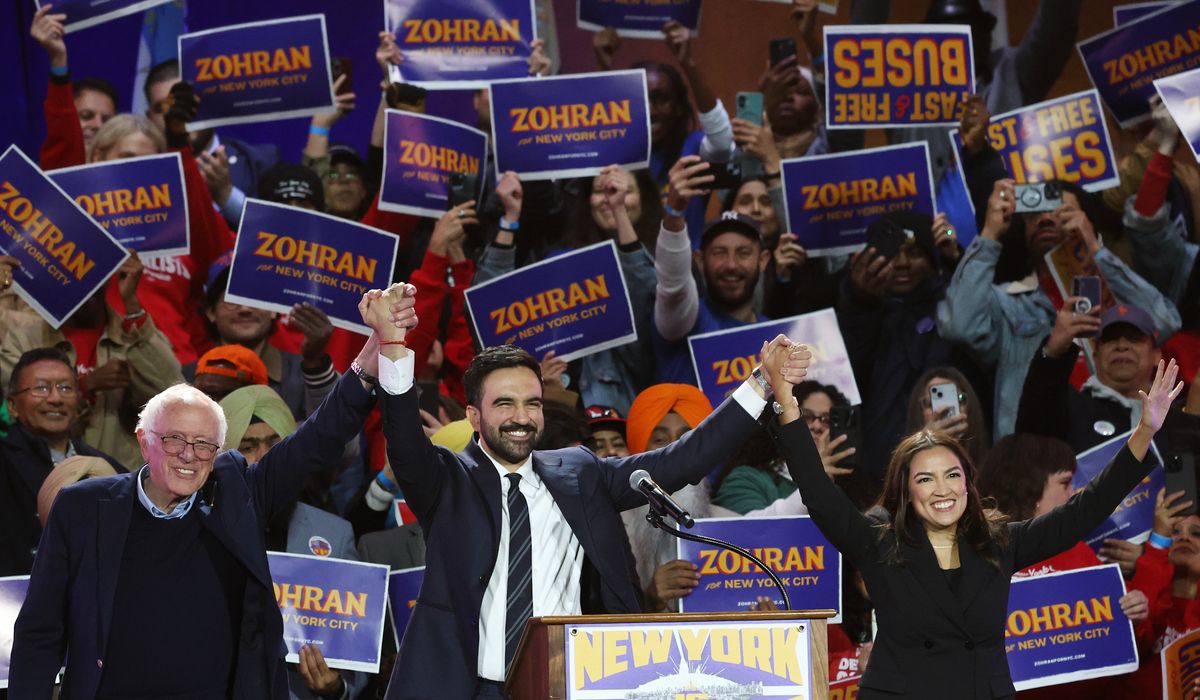
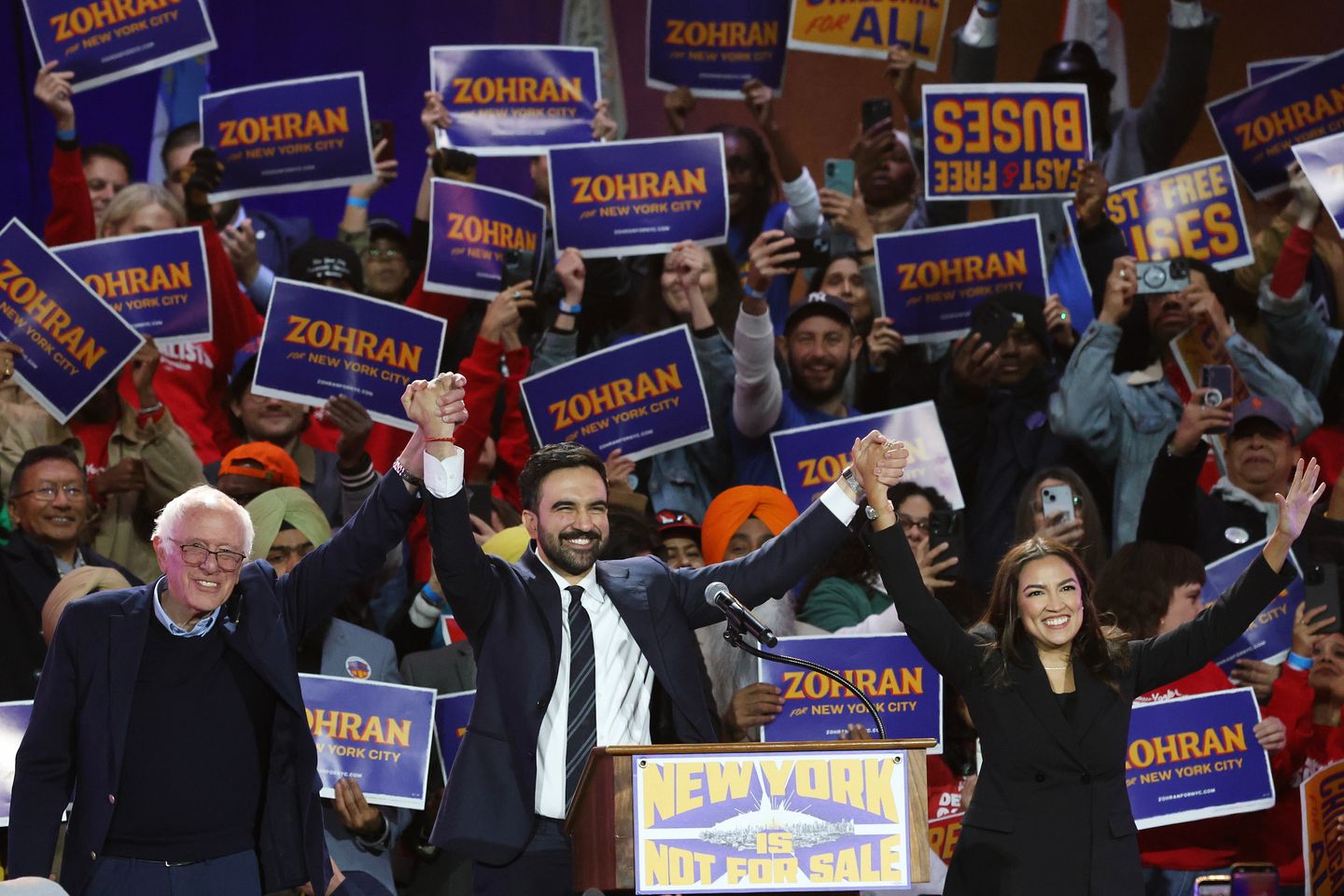
Young people came out in droves to elect democratic socialist Zohran Mamdani as the next mayor of New York. Exit polls showed 75% of voters aged 18-29 voted for Mr. Mamdani.
Mr. Mamdani has become the face of the socialist revolution within the party. But he’s not alone. Other rising stars in the party come from Congress’ far-left “Squad,” including Reps. Alexandria Ocasio-Cortez of New York, 36, Summer Lee of Pennsylvania, 37, and Greg Casar of Texas, 36.
A September poll from Data for Progress, a left-wing think tank, found that more than half of likely Democratic voters prefer socialist-aligned politicians, such as Ms. Ocasio-Cortez, Mr. Sanders and Mr. Mamdani, over Democratic leaders Sen. Charles E. Schumer and Rep. Hakeem Jeffries, both of New York.
There’s a leadership congestion in Congress, said Sanford School of Public Policy professor Mac McCorkle, a former Democratic consultant.
“There gets to be a kind of myth of indispensability, like we’re the only ones who understand,” Mr. McCorkle said. “Most older generations think the younger generations don’t understand.”
The “indispensability” dynamic was, in some ways, in play when President Biden sought reelection as an octogenarian. It also thrust the age issue for lawmakers into the spotlight and prompted a new round of calls for term limits.
Mr. Biden was 81 when his reelection run came to a disastrous early end with his mental fitness called into question. He was forced to drop out, and his vice president, Kamala Harris, took his place atop the ticket just months before the election, only to be handily defeated by President Trump.
“It’s going to be increasingly difficult for older Democrats who have been around for a while to justify their continued running for election,” said Jim Manley, a Democratic strategist who spent 21 years of his career in the Senate and served as a top aide to Senate Democratic leader Harry Reid.
“For many years, I was against term limits, a strong believer in the seniority system, and felt that with age comes wisdom,” he said. “I’m not so sure I agree with all those anymore. I still believe that with age comes wisdom. But given how poorly some Senate Democratic leaders have dealt with this issue over the years, I think there needs to be changes.”
Competitive primaries most often get launched when an older leader of the party retires or dies in office, said Amanda Litman, co-founder and president of Run for Something.
“It is telling that when an older Democratic leader retires (or, sadly, dies), a competitive primary with lots and lots of interesting candidates emerges — the gerontocracy’s selfish belief that ~they alone can lead~ is immediately proven false!” she wrote on social media.
The Democratic Party has long relied on young voters to boost its candidates, but the party establishment is now struggling to keep Millennials and Generation Z engaged and motivated to support party elders.
By contrast, Charlie Kirk and Turning Point USA amassed a huge following of college-age conservatives, and his death only spurred more chapters to be created at colleges across the country.
TPUSA was a “response to the need” of Republicans to attract young people, Mr. Dix said, and Democrats are falling short of responding to their party’s own needs.
“I don’t see that equivalent on the Democrat side, and that can be kind of a presumption that that voter base is just going to go their way,” he said. “But I think you can tell in recent elections that they can’t just be so sure about that, and they need to build that infrastructure if they’re going to be serious about engaging that community.”
The party has leaned heavily on celebrity involvement, and that was on display at the Democratic National Convention in July, where stars like Stevie Wonder, Maren Morris, Pink and John Legend performed. But that star power, apparently, is not as effective in reaching the younger generation as it once was.
“We as Democrats for many years did a very poor job of grooming our up-and-coming leaders,” Mr. Manley said. “That’s changing slowly but surely. We still have a ways to go.”