
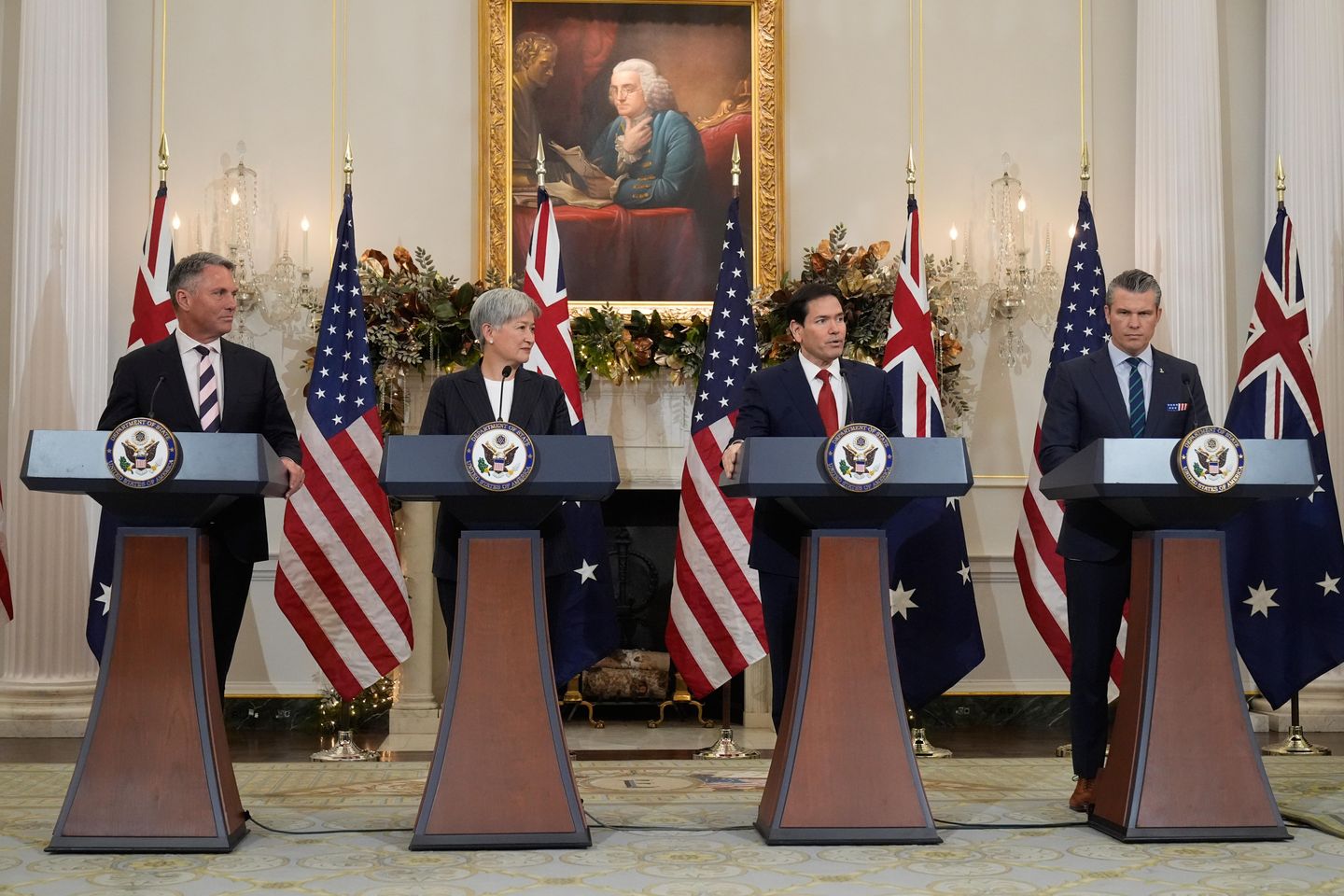
SEOUL, South Korea — Australia’s concerns about China’s rising might and jitters about America’s commitment to its Pacific allies were not eased by this week’s meetings between top officials from Sydney and the Trump administration.
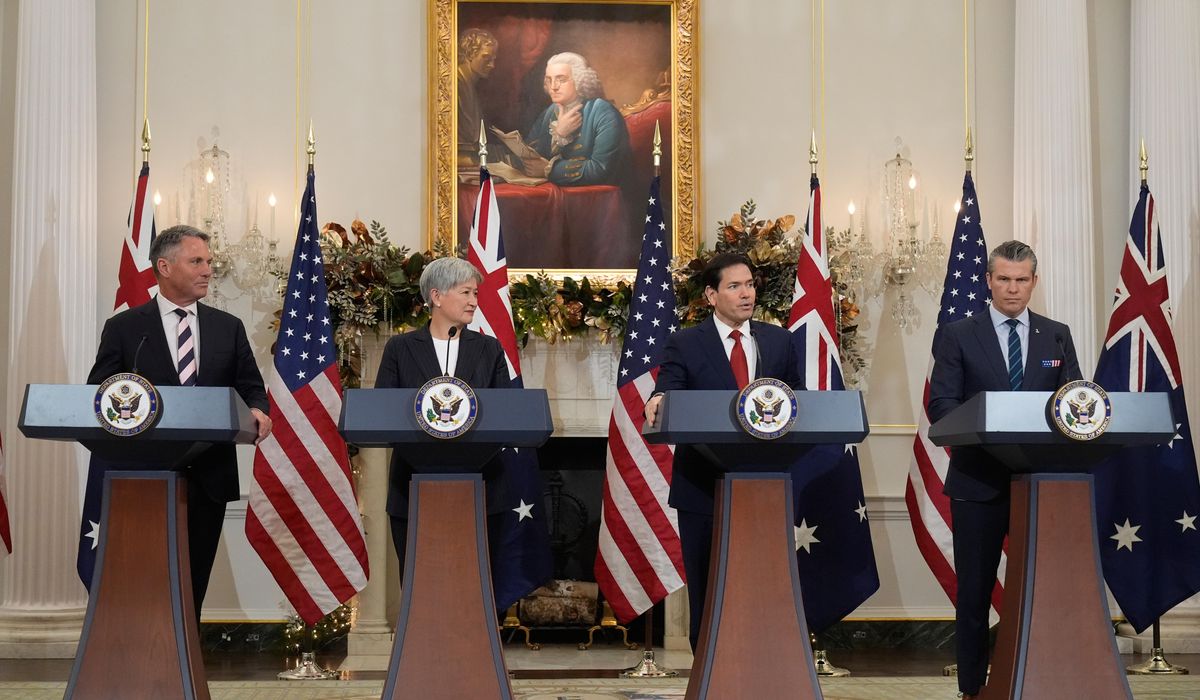
Australian Foreign Minister Penny Wong and Defense Minister Richard Marles met U.S. Secretary of State Marco Rubio and Secretary of Defense Pete Hegseth in Washington Monday.
The summit came amid disquiet in Canberra over the Pentagon’s review of a high-profile submarine deal and questions about the U.S. National Security Strategy, released on Dec. 4.
It also comes at the end of a year when the expanded capabilities made possible by China’s massive investments in modernizing its navy — the People’s Liberation Army Navy, or PLAN — were made very clear to both Australia and New Zealand.
Devil in the (dollar) details
The U.S. readout of the Monday “2+2” meeting was upbeat.
“This is an incredibly strong alliance,” Mr. Rubio said, noting Australia’s support for America’s recent conflicts. “It’s a strong alliance, and what we want to do is continue to build on it.”
Mr. Hegseth said air bases used by American forces in north and northeast Australia are being upgraded, “enabling additional U.S. bomber rotations,” while logistics and infrastructure in Darwin, Australia, are being upgraded so U.S. Marines can conduct “rotational deployments.”
Mr. Hegseth also spoke of upgrading the bilateral military-industrial base and Australian supplies to the U.S. of rare-earth minerals.
The reception in Australia a day later was more downbeat.
The Sydney Morning Herald titled its piece on the meeting, “Marles refuses 12 times to say what the Americans want in AUKUS review.”
AUKUS — short for Australia/U.K./U.S. — is a trilateral 2021 defense initiative, signed under the Biden administration. Its key pillar is the delivery to Australia of nuclear-powered attack submarines — a defense acquisition that, at an estimated $235 billion, is the most expensive in Australian history.
Three submarines are scheduled to be delivered beginning in 2032, after which Canberra and London will design and build a new class of vessels. But questions over the delivery timeline of the U.S. subs are not being answered.
U.S. Undersecretary of War Elbridge Colby was dubious about the provision of the submarines, due to the U.S. shipbuilding sector’s inability to supply enough Virginia-class boats even for the U.S. Navy.
That led to an internal Pentagon review, but in October, AUKUS regained momentum when President Trump, after his meeting with Australian Prime Minister Anthony Albanese, said AUKUS was “full-steam ahead.”
The results of the Pentagon review, however, have not been released. Mr. Marles gave nothing away.
“The thrust of the [U.S.] review was about how we can do AUKUS better,” he told Australian journalists who asked repeated questions in a post-summit press conference, the SMH reported. “I don’t think it’s appropriate that I go into it more than that.”
The SMH was not alone in its skeptical stance.
The Australian Financial Review quoted former Australian Prime Minister Malcolm Turnbull, who focused on the payments Canberra is making to Washington to upgrade U.S. shipbuilding capacities.
“To a lot of Australians, it looks like we’re paying money to the United States with no certainty at all of getting anything back for it,” Mr. Turnbull told the AFN. “If the government wants people to believe in the AUKUS project, then it needs to tell the truth about the deal, including any recent changes requested by the Pentagon and be transparent about it.”
It was agreed on Monday that Canberra would pay $1 billion to Washington by the end of the year. That follows an earlier payment this year of $1 billion to upgrade U.S. shipbuilding capacities.
Canberra is under pressure to not only keep paying Washington, but spend more on defense, according to the Australian Strategic Policy Institute, a think tank in the capital.
“Australia has resisted sustained U.S. pressure to shift defense spending toward 3.5% of GDP,” noted ASPI publication The Strategist, in its analysis of the U.S. National Security Strategy, or NSS. “The NSS makes clear that Washington views this position as increasingly untenable.”
With the U.S. merging the security and economic domains, there is pressure on allies to cut strategic reliance on economic powerhouse China.
The situation puts Australia “between a rock and a hard place of its own making,” The Strategist wrote. It noted that 63% of national exports in 2024 went to China, leaving Australia vulnerable to “self-deterrence driven by economic vulnerability.”
And China is well practiced at using economic leverage.
In 2017, after U.S. forces in South Korea established an anti-missile system, Beijing retaliated. A major Korean retailer was driven out of China, Korean auto sales slumped in the country, and imports of K-pop music were halted.
In 2020, when Canberra demanded an independent inquiry into the origins of COVID-19, Beijing responded with trade restrictions on Australian exports.
Currently Beijing, infuriated by Tokyo’s stance on Taiwan, has quashed Chinese outbound tourism and halted imports of Japanese seafood imports, movies and pop music.
Why Australia needs nuclear subs
It’s not just economics. China’s power in the naval sphere has also been placed before Australasian audiences.
On Monday, it was revealed that a New Zealand naval vessel monitoring international sanctions on North Korea was shadowed by seven separate Chinese vessels during its mission in the East China Sea, Yellow Sea and Taiwan Strait.
The waterways, proximate to China, are under the purview of multiple naval assets.
Reports from across the region’s maritime flashpoints — from the Philippines to Okinawa — are showcasing the expanding capabilities, range and hull numbers of the PLAN.
Last week, Australian Defense Chief Adm. David Johnson told parliamentarians that Australian forces were monitoring a Chinese task force comprising a helicopter carrier, a cruiser, a frigate and a logistics vessel in the Philippine Sea.
Over the weekend, Japan was shocked when Chinese carrier-borne fighters lit up Japanese fighters near Okinawa with their target radars.
And in February-March, a Chinese cruiser, frigate and supply ship sailed between Australia and New Zealand — in international waters — and conducted live-fire drills.
Though the actions were not illegal, the shoot caused flight disruptions. Both Auckland and Canberra seemed caught by surprise at the flotilla’s appearance.
Australia’s Lowy Institute called the Chinese maneuvers, “Awful but lawful,” describing them as a “show of force” and “a wake-up call to China’s burgeoning blue-water naval capabilities.”
The institute wrote that the best deterrent to Beijing’s surface forces, which outgun both Australia’s and New Zealand’s modest fleets, are the vessels promised by AUKUS.
“In peacetime, an SSN [submarine, submersible, nuclear] is the perfect tool to keep an eye on the operations of such a task force, while remaining unseen,” it wrote. “In wartime, the SSN is the perfect tool to send it to the bottom.”