
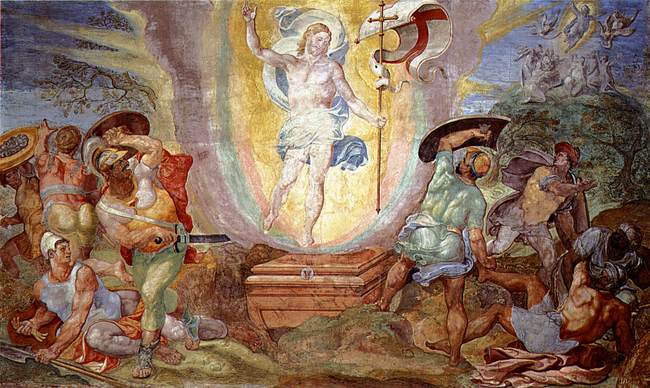
May all of our readers have a happy and blessed Easter celebration today! We would also like to wish our Jewish readers a belated, blessed Passover, which began on Wednesday.
Tonight’s Gospel reading from the Easter Vigil is Matthew 28:1–10, when the women come across the empty tomb and are the first to be told of Jesus’ resurrection:
After the sabbath, as the first day of the week was dawning, Mary Magdalene and the other Mary came to see the tomb. And behold, there was a great earthquake; for an angel of the Lord descended from heaven, approached, rolled back the stone, and sat upon it. His appearance was like lightning and his clothing was white as snow. The guards were shaken with fear of him and became like dead men. Then the angel said to the women in reply, “Do not be afraid! I know that you are seeking Jesus the crucified. He is not here, for he has been raised just as he said. Come and see the place where he lay. Then go quickly and tell his disciples, ‘He has been raised from the dead, and he is going before you to Galilee; there you will see him.’ Behold, I have told you.” Then they went away quickly from the tomb, fearful yet overjoyed, and ran to announce this to his disciples. And behold, Jesus met them on their way and greeted them. They approached, embraced his feet, and did him homage. Then Jesus said to them, “Do not be afraid. Go tell my brothers to go to Galilee, and there they will see me.”
How many of our readers have attended an Easter Vigil Mass? The first one I attended was in 2009; before then, we attended Sunday morning Easter Masses, which have their own special beauty. On that one occasion, however, we had been invited to attend the Vigil Mass because a friend of ours would be accepted into the Catholic Church for the first time … David Strom. Adult converts traditionally get baptized and confirmed at the Easter Vigil, and we were very excited to see David become a full member of the Church.
The beauty and majesty of the Vigil Mass completely amazed us, and we have attended it every year. Almost every year, I volunteer for a ministry in the Mass. In previous years, I served as lector and Eucharistic minister; in my new parish for the last five years, I have been singing in the choir. Serving in this Mass makes the Resurrection present and vibrant, even more so than the first time we participated as congregants.
What makes the Easter Vigil Mass so special? The readings walk us through the entire arc of Creation and salvation. When fully presented (some parishes will shorten it), this involves the blessing of fire, then seven readings that covers that arc: two from Genesis (creation and Abraham’s test), Exodus (the parting of the Red Sea), two prophecies from Isaiah, a lesson on wisdom from Baruch, the restoration prophecy from Ezekiel, along with sung psalms in between. All of this is done in near-darkness, until we get to the traditional form of Mass and all of the lights come on. The altar is re-presented, the catechumens welcomed, and we enter fully into the Octave of Easter as an Easter people, as one of my former and beloved pastors liked to emphasize.
All Masses are celebrations, but the Easter Vigil carries the drama and power of faith to make it feel like the triumph that it is.
It also answers the question that people have about Easter, even those of faith: Why? Why was it necessary? What made Jesus’ sacrifice the only possible way to salvation?
And the answer is: We did.
Yesterday, in my Good Friday reflection, I explained the construct of the “blood covenant.” These are usually bilateral, with both parties bound to pay blood penalties for violations of the covenant in order to restore it. In Genesis 15, however, the Lord caused Abraham to become immobile, and only the Lord passed through the sacrifices – meaning that only the Lord would pay the blood penalty, no matter who violated the covenant. When we continually violated that covenant, the Lord sent His only Son to pay in blood, one time for all eternity, to restore the covenant and ensure we could seek salvation through the sacrifice of Jesus.
That only explains the mechanism, I realized later during the Good Friday service. It answers the question of how, not why. In a general sense, the limitless self-sacrificing love of the Lord addresses the motive, but not the question of necessity. The Lord could have simply negated the covenant and abandoned us, but He loves us too much for that. He could have ignored the covenant and saved us all regardless of whether we chose Him or not, but to do that, He would have to enslave us and force us to accept Him on His terms.
This brings us back to the covenant itself and the Lord’s decision to carry the blood-atonement requirement alone. Why would He do that? The answer to that question is simple, and devastating: He knew we would fail. He knew we would fall into the slavery of sin and that we would rebel against His Law and His Word. Humanity had done that since the Garden of Eden, through the Great Flood, and would go on to rebel even as the Lord brought His people out of Egypt and offered them the Promised Land. He could directly tell Adam and Eve not to eat the forbidden fruit; He could write His law on stone tablets; he could send dozens and hundreds of prophets to remind His people to obey the covenant, and we would fail every time and every test.
The Lord knew all of this … and loves us anyway. He loves us so much that He promised to pay the blood atonement that we could never sufficiently pay ourselves. The Lord loves us all, collectively and individually, and He did not want our corrupted natures to prevent us from being reunited with Him in eternity if we chose the covenant and His mercy.
We still must choose that covenant and acknowledge our sins, repent of them, and atone for the suffering those cause, but not in blood. Jesus paid for our salvation with His blood, once and for all who acknowledge Him as their savior. The Lord foresaw our failure and ensured that we could come to Him, undeserving though we are under the terms of the blood covenant, while still respecting our free will choice to accept Him and remain in the covenant. In that way, we come to Him not as slaves or into eternity as corrupted beings, but as His adopted sons and daughters, entering into the purity of the Trinitarian family of love.
The Vigil Mass reminds us of all this, represented by the readings that we heard tonight that remind us of the arc of creation and salvation. We were made to love Him, and to choose that love on our own. Christ makes that possible by paying the debt we cannot carry, and the Gospels carry that message to the ends of the world.
Easter presents us with another question: Why the Resurrection? In terms of historical context, it settled the question brewing at that time between the Sadducees and the Pharisees about life after death. (The Sadducees didn’t believe in an afterlife, while the Pharisees did.) More importantly, it reminded us that we are beings of both matter and spirit, and that spirit is eternal. What we do in this life, what we choose, and what we hold in our hearts have eternal consequences. Mortal death is not the end for us, as Jesus revealed in the tomb on that first Easter morn. The Lord wants to bring us all to our true eternal home, the one rejected by Adam and Eve in favor of rebellion and usurpation of God’s authority, the basis of all sin.
Jesus’ resurrection shows the eternal nature of the Word and its eternal promise. It is that promise, along with the immeasurable love of the Lord, that we celebrate today.
May your Easter season be filled with love and joyous wonder!
The front-page image is “The Resurrection of Christ” by Hendrick van den Broeck, c. 16th century. On display in the Sistine Chapel, at The Vatican. Via Wikimedia Commons.
“Sunday Reflection” is a regular feature, looking at the specific readings used in today’s Mass in Catholic parishes around the world. The reflection represents only my own point of view, intended to help prepare myself for the Lord’s day and perhaps spark a meaningful discussion. Previous Sunday Reflections from the main page can be found here.