
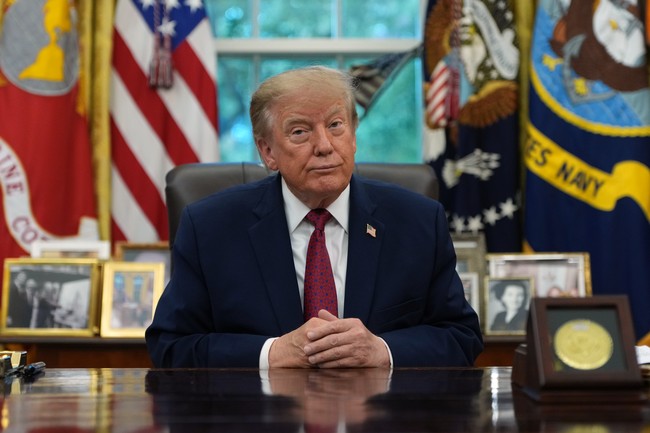
President Donald Trump has an opening to pursue an agreement with Iran while keeping American pressure in place. He should use it without confusing encouraging conversations with concessions Tehran has actually made.
After meeting Qatar’s prime minister, Mohammed bin Abdulrahman Al Thani, at the White House in Washington on November 9, Trump described “positive momentum” toward ending the conflict. He also reaffirmed that preventing Iran from acquiring a nuclear weapon remains nonnegotiable.
From Anadolu Agency:
“I had an excellent conversation with Sheik Mohammed bin Abdulrahman bin Jassim Al Thani, the Prime Minister of Qatar, wherein much was discussed with respect to the Islamic Republic of Iran,” he said on his Truth Social platform.
Trump also said that Qatar, Saudi Arabia, the United Arab Emirates, Bahrain, Kuwait and other regional countries “would prefer the status quo, in other words, a continuation of the Greatest Naval Blockade in History, and the new Operation Iron Gate — Therefore, Land and Sea.”
The combination is sensible. A president should seek an outcome that protects Americans without ordering another round of attacks when negotiations might deliver the objective. Keeping military options available gives diplomacy weight. Restraint gives those options a purpose beyond repeated use.
Trump said Gulf partners prefer maintaining the current blockade and Operation Iron Gate rather than renewed escalation. His statement described continued pressure alongside negotiations, rather than announcing that Washington had lifted its restrictions or accepted Iran’s terms.
Qatar’s prime minister also welcomed discussions with Trump and Vice President JD Vance about advancing the talks. Neither side’s public account announced a completed agreement. The meeting produced encouraging statements, but decisive work still lies ahead.
Americans have good reason to welcome a genuine opportunity to end the fighting. Service members and their families bear consequences that never fit neatly into a presidential announcement. A durable settlement would protect lives and reduce the risk of another emergency requiring American forces.
The question is what Iran must do, when it must do it, and how compliance will be verified. Those details determine whether negotiations reduce a threat or merely postpone the next confrontation.
Secretary of State Marco Rubio supplied important context on November 8, saying indirect negotiations had produced little progress and characterizing Iranian demands as unacceptable. His assessment came before Trump’s meeting with the Qatari leader, but it cautions against declaring a breakthrough based on optimism alone.
Iran’s proposal seeks an end to the American blockade, relief from some sanctions, and a halt to bombing in exchange for reopening the Strait of Hormuz, with nuclear negotiations to follow. Iranian officials defend the proposal, while Washington has rejected its conditions.
The sequence matters because concessions have different practical effects. Releasing money or easing restrictions can provide an immediate benefit. A promise to negotiate later leaves the central nuclear dispute unresolved.
Any interim arrangement should therefore specify measurable obligations, deadlines, and consequences. Inspectors need access sufficient to establish what exists and whether commitments are being honored. Enforcement should remain possible when a violation occurs, without requiring another prolonged argument about whether anyone is allowed to respond.
The administration should also explain which restrictions would change at each stage. Americans shouldn’t have to guess whether relief follows verified action or precedes it. Clear terms would help Congress and the public evaluate both the agreement and its implementation.
Qatar can help carry messages and narrow differences. Its willingness to mediate doesn’t establish that Iran has accepted Washington’s objectives. Trump should welcome useful assistance while retaining responsibility for judging the terms himself.
Conservatives can support that effort without demanding escalation as proof of toughness. They can also insist that favorable language receive the same scrutiny they would apply under a Democratic president. The objective remains American security, regardless of who receives the diplomatic credit.
Trump has room to negotiate; he should preserve that room by avoiding promises that make a quick agreement politically necessary. An enforceable settlement is worth pursuing; a deadline created by presidential enthusiasm would weaken his position.
Welcome the opening, keep the pressure tied to clear objectives and verifiable commitments.
Then judge the results by what Iran does after the meeting ends.
Diplomatic promises need scrutiny, whoever occupies the White House. Join PJ Media VIP for independent conservative commentary and get 60% off with promo code FIGHT.