
President Donald Trump turned Chinese President Xi Jinping’s “declining nation” line into a clean political contrast. Xi meant it as a warning about American weakness, while Trump treated it as a diagnosis of President Joe Biden’s years in power.
President Donald Trump turned Chinese President Xi Jinping’s “declining nation” line into a clean political contrast. Xi meant it as a warning about American weakness. Trump treated it as a diagnosis of Joe Biden’s years in power.
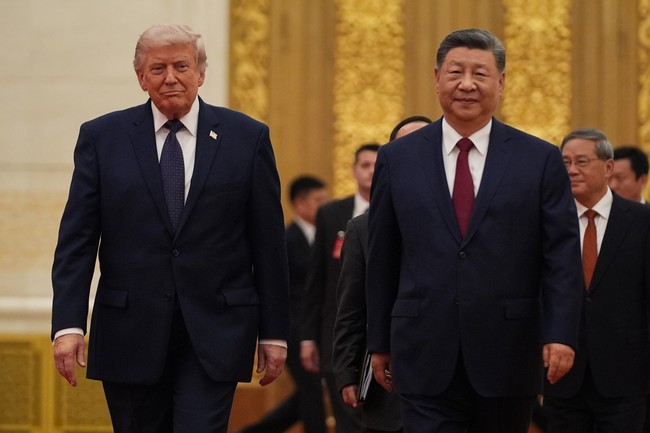
Xi met with Trump at the Great Hall of the People in Beijing during Trump’s state visit to China. Both leaders spoke about keeping relations from sliding into open confrontation, while Xi also warned about Taiwan and the danger of mishandling the world’s most important bilateral relationship.
As shared by writer Diyar Güldoğan, Trump said he hoped U.S.-China ties would become “stronger and better than ever before.”
Trump blamed the Biden administration for what he described as economic weakness, immigration problems, crime and social policies he opposes, including diversity, equity and inclusion initiatives.
At the same time, he portrayed his administration as having restored American economic and military strength during what he called “16 spectacular months” in office.
He cited a record stock market performance, strong employment numbers, increased foreign investment and military successes abroad as evidence of renewed US power.
“In fact, President Xi congratulated me on so many tremendous successes in such a short period of time,” Trump wrote.
“Two years ago, we were, in fact, a Nation in decline. On that, I fully agree with President Xi! But now, the United States is the hottest Nation anywhere in the world,” he said.
Trump’s answer worked because it refused the old American habit of absorbing foreign insults with a nervous smile. He didn’t deny weakness existed; he located it and laced it under Biden—where it belongs. The record gives him plenty of material: border chaos, inflation pressure, retreat abroad, confused diplomacy, and a government tone that too often sounded embarrassed by American strength.
Xi’s line may have sounded elegant in Beijing, but Trump turned it into a campaign-sized reminder that decline doesn’t arrive by weather pattern. Leaders choose policies, and nations pay the bill.
And, as the New York Post writes, relations between the two countries may have crossed a Chinese-generated line.
Xi referenced a geopolitical concept known as the Thucydides trap, or the risks that arise when an emerging power challenges a stronger, more established power.
“The whole world is watching our meeting,” Xi began inside Beijing’s Great Hall of the People, with Trump seated across the table.
“Currently, transformation not seen in a century is accelerating across the globe, and the international situation is fluid and turbulent,” he continued, according to one translation of his remarks. “The world has come to a new crossroads.
“Can China and the United States overcome the Thucydides trap and create a new paradigm of major country relations? Can we meet global challenges together and provide more stability for the world? Can we, in the interest of the well-being of our two peoples and the future of humanity, build a brighter future together for our bilateral relations?”
Xi has referred to the Thucydides trap, a term coined by Harvard professor Graham Allison, since at least 2014 regarding the US. The concept was named after ancient Greek historian Thucydides, who wrote that the rise of Athens put Sparta in such a defensive posture that war was inevitable.
“What Xi Jinping said in that speech is that we can transcend the Thucydides trap,” Sky News Asia correspondent Helen-Ann Smith said. “So what he’s saying is that, you know, ‘We are an upcoming power and you should not be threatened by us.’
“That’s his key message.”
The wider Beijing meetings also carried real stakes. Treasury Secretary Scott Bessent said Washington and Beijing can discuss AI guardrails because the United States leads in AI.
Secretary of State Marco Rubio said America respects China’s ambitions but won’t accept Chinese gains that come at America’s expense.
Those comments fit Trump’s posture; he wants dialogue, deals, and stability, but he isn’t eager to bow before foreign kings or kneel for the privilege of being lectured by Beijing.
Plenty of people (D’s!) in Washington will hate Trump’s framing because it gives him the upper hand. They wanted Xi’s remark to land as proof that China still sees America as weak. Trump turned the insult around and made Biden carry it. More importantly, he used the moment to argue that America’s decline was never permanent; it came from bad leadership, bad priorities, and bad instincts.
Replace those, and the country starts breathing differently.
Trump also knows something many career diplomats forget: tone carries power; nations, markets, and adversaries hear confidence.
Allies hear it too.
A president who walks into Beijing and says America is back sends a different message than one who explains limits, asks for patience, and acts as if managed decline qualifies as statesmanship. Xi may have meant to describe America’s slide. Trump answered by saying the slide ended when Biden lost his way off the stage. Again.
The line will annoy the right people, which probably means it landed where Trump wanted it. He accepted the charge only long enough to redirect it. Biden’s American looked tired, defensive, and unsure. Trump’s America wants factories humming, farmers selling, companies competing, and rivals negotiating with a president who doesn’t confuse politeness with surrender.
Xi gave him a phrase; Trump turned it into a verdict.
VIP members keep columns like these alive when the establishment narrative needs a hard shove back toward reality. Use promo code FIGHT for 60% off VIP access.