

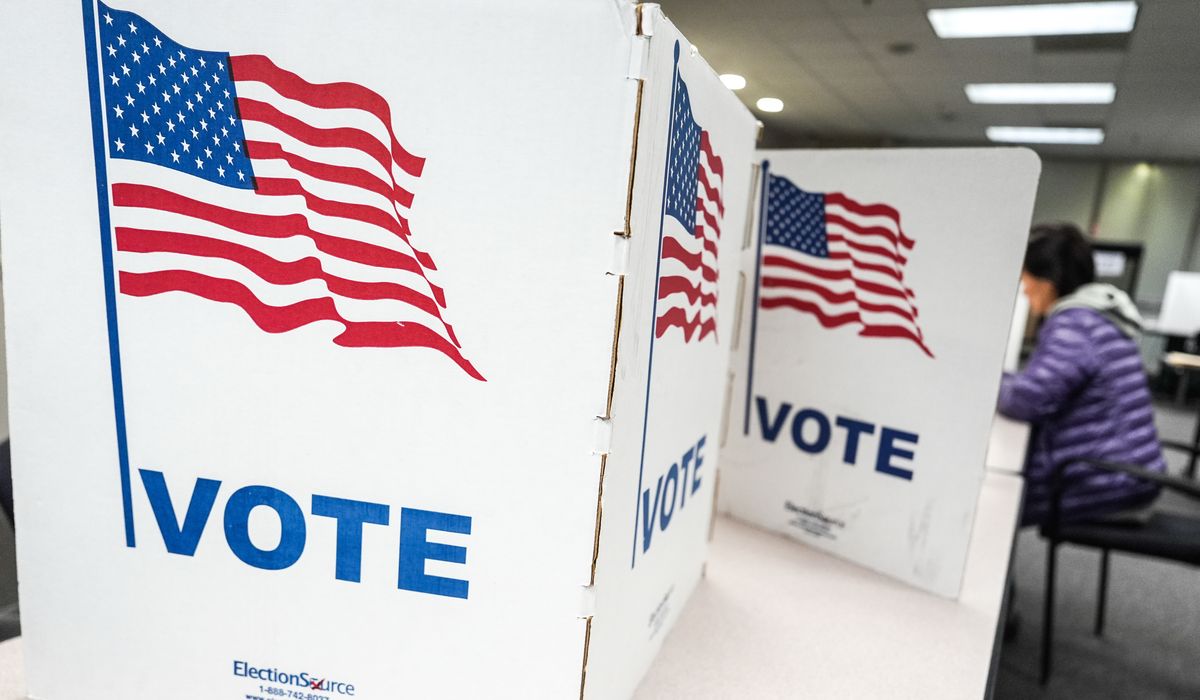
In one of the most important congressional redistricting battles ahead of the 2026 midterm elections, voters in Virginia approved a new map that will eliminate nearly all of the state’s Republican representation in the U.S. House after 2026.
A narrow majority of voters said “yes” to a ballot question asking to allow the Virginia General Assembly to temporarily install new congressional districts “to restore fairness in the upcoming elections.”
With 88% of the vote counted, the “yes” vote led by 51% to 49% and multiple news organizations had called the race by 9 p.m., considering what areas still had to be counted.
Democratic leaders in the state sought voter permission for outright gerrymandering in order to counter partisan congressional maps carved in Texas and other red states.
The state’s newly elected Democratic Gov. Abigail Spanberger, once an opponent of gerrymandering congressional districts, defended the proposed lopsided map in Virginia as a response to GOP gerrymandering maps in other states.
“Today’s redistricting referendum is about one thing: President Trump’s power grab,” she said Tuesday.
“Last summer, he said he’s ‘entitled’ to more seats in Congress, and states across the country got to work to give him what he demanded. You can push back, Virginia. Vote yes,” she added.
The state constitutional amendment approved by voters on Tuesday will revert to the standard redistricting process every decade after the 2030 census.
But in the meantime, Tuesday’s vote will make Virginia’s congressional map the most gerrymandered in the nation, wiping out nearly all of Virginia’s Republican representation in Congress.
The Democrat-led general assembly drew congressional lines that will eliminate four Republican-leaning districts.
The new map will virtually ensure Virginia elects 10 Democrats and just one Republican to the U.S. House in the November election.
But in the last presidential election, Democrat Kamala Harris only defeated Mr. Trump by 52% to 46%, a split roughly reflected in the state’s current U.S. House delegation of six Democrats and five Republicans.
Democrats celebrated the win as a repudiation of the GOP and President Trump’s agenda, but the new map faces a court challenge.
The Republican National Committee, the Republican Party of Virginia, and a group of Virginia voters filed a lawsuit in state court challenging the legislature’s authority to gerrymander the map.
Republicans were significantly outspent by Democrats ahead of Virginia’s referendum as Democrats dumped tens of millions of dollars into advertising and get-out-the-vote efforts.
Much of the money came from a super PAC associated with House Minority Leader Hakeem Jeffries, New York Democrat.
Mr. Jeffries, who would likely become House speaker if Democrats win control of the House, was among national party leaders who campaigned in Virginia in favor of the new map.
He told reporters the redrawn congressional lines make the national congressional map “fairer,” because Virginia voters would ultimately decide whether to approve the changes.
In other states, the new lines were drawn by legislatures without voter input, a move he said would “rig” the midterm elections.
“This effort has failed because Democrats haven’t stepped back, we fought back,” Mr. Jeffries said.
The new lines in Virginia will help Democrats in their quest to take back the House majority, which Republicans now control by only two seats.
Republicans campaigned aggressively against redistricting in rural districts, warning voters their Republican representatives in Congress will be eliminated if the redistricting map prevailed.
Early and mail-in voting showed the electorate was nearly evenly divided on the issue, but Democrats pulled out ahead on Tuesday.
The newly approved districts will pack many of the state’s Republican voters into one oversized district in the southwestern part of the state that now corresponds with a seat held by GOP Rep. Morgan Griffith.
The remaining GOP-leaning districts were redrawn to dilute Republican voters and are likely to flip to Democratic candidates.
The targeted Republican seats are now held by Reps. Robert Wittman, Jen Kiggans, John McGuire and Ben Cline.
In Alexandria, voter Sam Sterling, 38, rejected the proposed map.
“It just seems like this redistricting is very, very biased, and there’s a clear plan behind it, and I’m just not in favor of it,” said Mr. Sterling, a real estate developer.
Democrats blame Republicans for igniting a nationwide redistricting war that began in Texas.
That state’s Republican lawmakers last year redrew the state’s congressional map to carve out five new GOP-leaning districts. Other states followed Texas.
Pete Reischauer, 52, an Alexandria social worker, said the proposed temporary maps are justified, “to be able to level the playing field a little bit.”
Before Tuesday’s vote, Republicans had gained a net three-seat advantage in redistricting so far that has taken place in California, Missouri, North Carolina, Ohio, Texas and Utah, according to Ballotpedia, which is tallying the redistricting fight.
Redistricting efforts in Georgia, New York and Louisiana remain subject to litigation and court decisions.
But Republicans still have one card to play as Florida is likely to be the last state to act in the nationwide gerrymandering battle.
Republican Gov. Ron DeSantis called a special legislative session to convene on April 28. Lawmakers will consider a handful of bills, among them a measure that would redraw congressional districts to give the GOP up to an additional five seats.
The state’s mid-century redistricting battle is an abrupt about-face from the recent creation of the bipartisan Virginia Redistricting Commission.
In an overwhelming bipartisan vote in 2019, the General Assembly moved to amend the state Constitution to give the map-making job to a commission. Virginia voters approved the change in November 2020.
Previously, the legislature drew the new district maps and approved them through the normal legislative process.
The ballot question asked voters to allow the General Assembly to temporarily redraw new congressional districts “to restore fairness in the upcoming elections,” a widely criticized choice of words that could be the focus of more legal wrangling.
The amendment would return Virginia to the standard redistricting process every decade after the 2030 census.
• Kerry Picket contributed to this report