

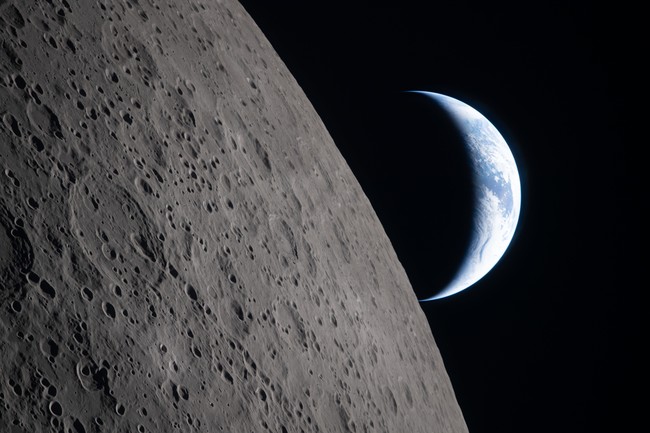
The Artemis II mission is almost at an end. In just a few hours the Orion spacecraft will enter earth’s atmosphere and eventually splashdown in the ocean off the coast of California.
The teardrop-shaped crew module, which carries the four astronauts, is scheduled to separate from the service module, which powers and propels the spacecraft, at 7:33 p.m. [ET] This signals that the crew is preparing for re-entry into Earth’s atmosphere.
The separation will expose the crew module’s heat shield, which is designed to protect Orion from blistering temperatures as it races through Earth’s atmosphere.
The spacecraft’s speed will be nearly 24,000 miles per hour as it hits the atmosphere. It will then use parachutes to slow it to about 335 m.p.h., and then 20 m.p.h. or less. It will then splash down in the Pacific Ocean.
Following splashdown, recovery teams from NASA and the U.S. Navy will stabilize the Orion capsule and then help the crew board helicopters that will deliver them to the U.S.S. John P. Murtha. The crew will undergo medical evaluations on the ship before traveling back to shore. Eventually they will fly to NASA’s Johnson Space Center in Houston.
The splashdown is expected to happen at 8:07 pm ET or 5:07 pm on the west coast. NASA will once again have live coverage for about 90 minutes before the splashdown and I’ve posted that video below. At the time this post goes up you should have a few minutes to catch it come down.
Because the spacecraft is speeding in over the Pacific Ocean and splashing down more than a hundred miles off the coast (around two hours before sunset in the same direction), NASA doesn’t expect the crew module’s splashdown to be visible to people along the coast. However, because it will be moving a more than 30 times the speed of sound, it could set off some sonic booms.
The mission so far has gone remarkably smoothly apart from a few problems with the space toilet. But reentry is the part of this that some observers have been most concerned about. That’s because, as CNN puts it, the crew module’s heat shield is “sub-optimal.”
Several former NASA engineers and a former astronaut have expressed concern to CNN that the heat shield on the bottom of Orion that’s designed to protect the crew from extreme temperatures isn’t safe.
This vital piece of hardware is nearly identical to the heat shield flown on Artemis I. That 2022 uncrewed test flight returned from space with its 16.5-feet (5-meter-wide) shield pockmarked by unexpected damage — prompting NASA to investigate the issue…
Heat shields on future Orion capsules will be adjusted in the hopes of preventing cracking entirely. The Artemis II heat shield was not changed, but NASA says it addressed the issue by adjusting the reentry flight path.
NASA’s solution to the heat shield problem was for the spacecraft to come in at a steeper angle.
To prevent damage to the Orion capsule’s heat shield similar to that discovered after the uncrewed Artemis I flight in 2022, NASA has modified the spacecraft’s re-entry path.
This time, the Orion capsule will descend at a steeper angle, reducing the spacecraft’s exposure to the most extreme temperatures of re-entry from 20 minutes to 13.5 minutes, according to NASA. Temperatures while plunging through the atmosphere can reach 4,000 to 5,000 degrees Fahrenheit.
So that’s the plan. Come in fast so the heat shield isn’t exposed to that extreme heat for as long. Weather is another potential problem but so far it seems to be relatively calm and cooperating in the splashdown area.
Here’s the NASA coverage which should be live and only minutes away as this post goes up.
Editor’s Note: Do you enjoy Hot Air’s conservative reporting that takes on the radical left and woke media? Support our work so that we can continue to bring you the truth.
Join Hot Air VIP and use promo code FIGHT to receive 60% off your membership.