

ISTANBUL — The two-week ceasefire between the United States and Iran cracked on the first day. Israel on Wednesday launched its largest strike on Lebanon since the war began, killing more than 250 people. Iran called it a grave violation and threatened strong responses.
The Strait of Hormuz remains largely closed. Peace talks are scheduled in Islamabad on Friday.
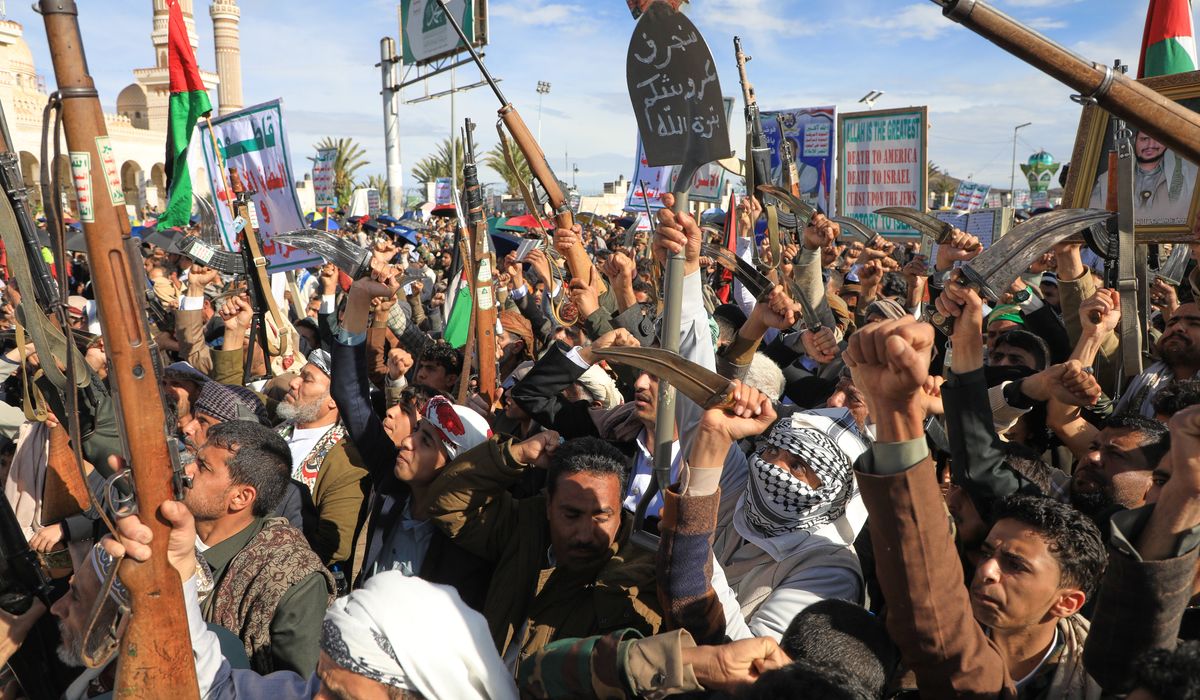
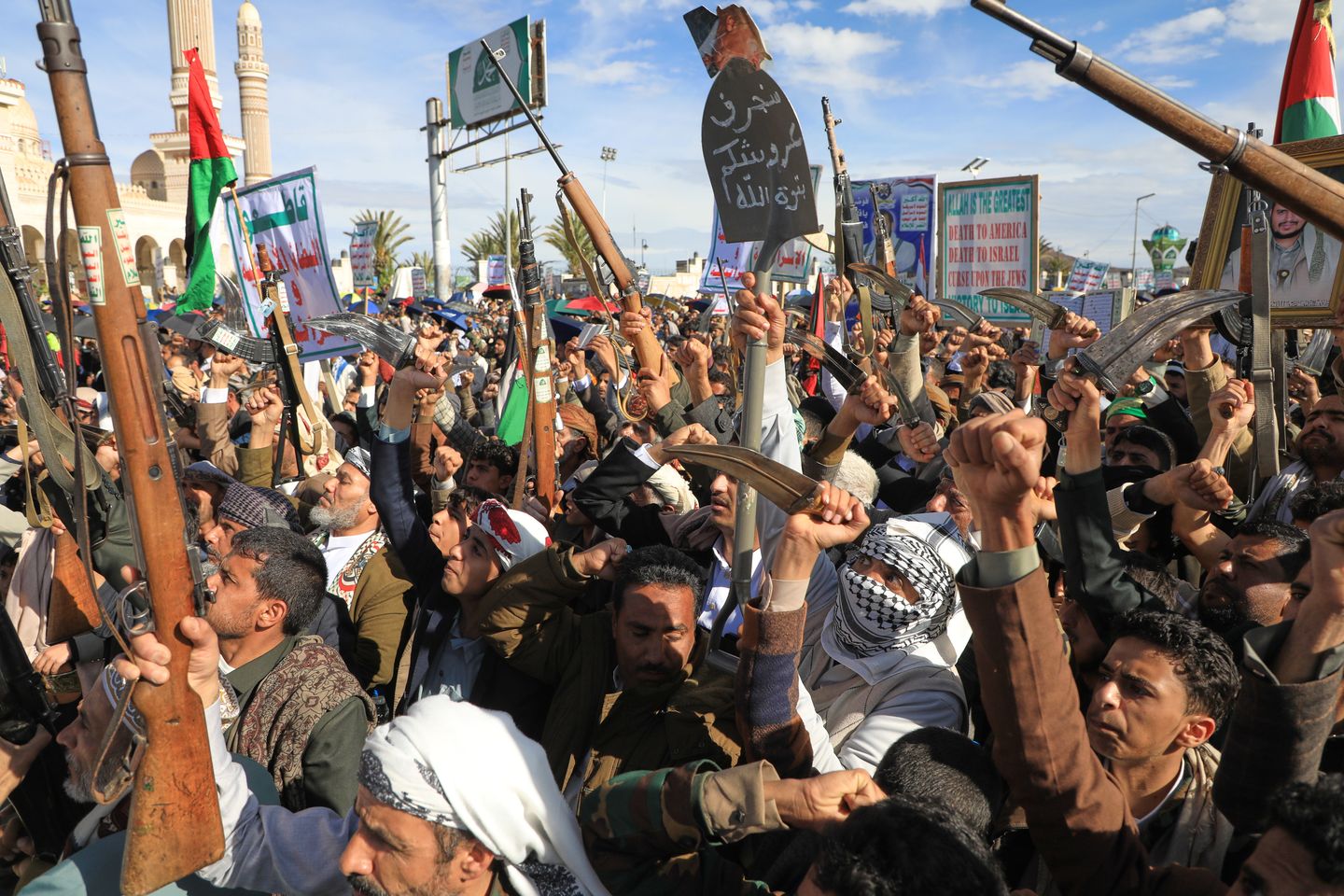
The Yemen-based Houthis — Iranian proxies waging civil war against their own government while regularly lobbing missiles at Israel — were not party to any of it. They have not said a word.
The ceasefire Pakistan brokered named no Houthi obligations and set no conditions on Yemen. What the militant group has done instead is begin screening ships transiting the Red Sea by political identity — using the same selective-pressure formula Iran applied to the Strait of Hormuz. Every party to this conflict is focused on Lebanon, Hormuz and Islamabad. The Houthis are focused on Hodeidah — Yemen’s fourth-largest city and the country’s principal port on the Red Sea.
Since March 28, the Houthis have launched at least eight barrages at Israel — the last confirmed strike was a drone intercepted near Ramon Airport on Tuesday, the day of the ceasefire announcement. One day earlier, the group joined Iran and Hezbollah in a three-way coordinated barrage of cruise missiles and drones. All strikes have been intercepted. None has caused casualties.
Senior Houthi political official Mohammed al-Bukhaiti said the current strikes on Israel are only a first phase. The airport strikes are an irritant. What the Houthis can do from their Red Sea port at Hodeidah is much more consequential.
The Houthis have not acknowledged the ceasefire publicly. Their satellite channel, Al-Masirah, carried Iranian messaging Thursday that framed any pause in fighting as a chance to regroup — not a path to peace. In Lebanon, Hezbollah resumed rocket fire on northern Israel within hours of saying it had stopped, pointing to continued Israeli airstrikes as justification. The Houthis have said all along they will stand down only when the fighting stops on every front. It has not stopped on any of them.
The Houthi deputy information minister has called it a battle conducted “in stages.” He said closing Bab al-Mandab — the 20-mile-wide chokepoint connecting the Red Sea to the Gulf of Aden — is among the group’s options.
The strikes on Israel do not technically violate the May 2025 understanding the group reached with Washington, under which it agreed to stop firing on U.S. Navy vessels and commercial shipping. That deal said nothing about Israel.
A senior Houthi official said the group would respect the ceasefire with Washington only as long as the U.S. honored its own commitments — and added that the group possessed “the military capabilities necessary to protect Bab al-Mandab.”
That is a price list, not a ceasefire statement.
Saudi Arabia rerouted its oil exports through the Red Sea port of Yanbu after Iran effectively closed the Strait of Hormuz. The East-West pipeline runs hundreds of miles across the Arabian Peninsula, pumping at its full capacity of 7 million barrels a day. The kingdom moved its crude exports 750 miles overland to escape one chokepoint and delivered them within Houthi missile range of another. Crude exports via Yanbu have reached 5 million barrels a day.
“What we are seeing is Iran running this conflict in phases — its own capabilities first, then Hezbollah and the Iraqi factions, now the Houthis and the threat to Red Sea navigation,” said Maher Abu al-Majd, an Istanbul-based Yemeni journalist and political analyst. “Tehran is deciding when to move up each rung. There is a broader Iranian operations room sequencing the fronts.”
On March 28, the European Union’s 19-nation Red Sea naval mission, known as Aspides, revised its threat assessment for the region, stating that Houthi military capabilities “remain intact and substantial.”
Aspides has been escorting commercial vessels through Red Sea shipping lanes since the last Houthi campaign — the same lanes that carry goods into American ports. It raised the threat level to high for vessels affiliated with Israeli or American interests and warned that the next phase of Houthi involvement could include renewed attacks on commercial shipping.
Former U.S. deputy chief of mission in Yemen Nabeel Khoury said the missile strikes on Israel so far amount to “token participation, not full participation” — a signal the group is still in play, aimed at deterring a full assault on Iran rather than committing to one of its own. The ceasefire has not resolved that calculation. It suspended the pressure that contained it.
Aspides is the only standing international force currently escorting commercial vessels through the Red Sea corridor. An Aspides official said the mission “maintains a high level of situational awareness and conducts daily assessments of potential risks to freedom of navigation.”
“In the event of a resumption of Houthi attacks to merchant vessels — which remains a possibility — we are present and ready to implement our mandate,” the official said.
The EU extended Aspides to February 2027 in anticipation of renewed pressure along the Red Sea corridor, even as resources remain finite.
The mission has two to three warships on station at any given time.
A resumption of attacks on shipping could have consequences for global energy supplies assessed as potentially greater than the closure of the Strait of Hormuz, given the volume of Saudi crude now transiting Bab al-Mandab.
Aspides cannot strike Houthi positions on land. Its mandate is escort and defense only. A renewed Houthi maritime campaign would not only threaten shipping — it would compete with Operation Epic Fury for American air defense munitions already under severe strain across the region.
Ahmed Nagi, senior Yemen analyst at the International Crisis Group, said analysts spent a month misreading the group’s posture. “Their delayed entry reflected a calculated decision taken in coordination with Tehran,” Mr. Nagi said. “The question, as the Houthis themselves framed it, was not whether to join the fray, but when.”
The port from which any maritime escalation would be launched is already operating without international oversight.
Hodeidah, on Yemen’s Red Sea coast, handles 80% of the country’s humanitarian supplies and is the main facility through which Iran has been moving weapons to the Houthis, according to Israeli and American military statements.
Since last year’s Israeli strikes, Iran’s Yemeni proxies have built two new piers there, expanded a third connected to an artificial island, and shifted bulk cargo operations north to Ras Issa — a former oil terminal now handling general freight. The UN mission that monitored the facility commenced liquidation April 1.
The World Food Program is gone. For the first time in six years, no one with international standing is watching what goes in or comes out.
Al Arabiya, the Saudi-owned satellite channel whose editorial line tracks closely with Riyadh and Abu Dhabi, published an analysis on Wednesday, April 2 — the day after the U.N. mission commenced liquidation — calling for the Hodeidah front to be reopened, framing the port’s unmonitored status as the primary remaining threat to regional navigation.
Regional intelligence officials tracking the coastline say Abu Dhabi’s direct military footprint in Yemen has been significantly reduced since UAE forces withdrew in January, leaving visibility now largely dependent on surveillance and coordination with local networks. What that surveillance shows is a persistent threat posture: active UAV patrols, automatic identification system tracking and small boat operations along the Hodeidah coastline.
The infrastructure required to pivot rapidly to direct maritime operations against Red Sea shipping remains firmly in place and primed for use at the group’s discretion, officials said.
Saudi Arabia made a decision in January that removed the most effective anti-Houthi military force from southern Yemen. Riyadh disbanded the UAE-backed Southern Transitional Council — a battle-hardened separatist militia that had spent years holding the coastline near Bab al-Mandab — and replaced it with a plan to build a unified national army from scratch.
That army does not exist yet. Stopping a Houthi maritime operation from inside Yemen is not currently possible, the officials said. The only tools available are offshore — U.S. and allied naval patrols, European escort missions and targeted airstrikes.
No Yemeni ground force is in a position to project power onto the Houthi-held coastline.
Cauvery Ganapathy, a fellow at the Observer Research Foundation’s Middle East program, an Indian foreign policy think tank based in Abu Dhabi, said a full closure of Bab al-Mandab is less likely than a sustained campaign of economic disruption.
“The more relevant consideration is not whether this can be closed off entirely, but whether transit is economically viable,” Ms. Ganapathy said. The Houthis have already moved toward formalizing their control of the strait as an economic asset, she said. “They have reportedly been collecting tolls to ensure safe passage. Risk insurance and freight insurance would already be pricing this in. I think this has already entered the ledger.”
Egypt has already priced one version of this scenario. The Suez Canal was recovering when the Iran war erased those gains on Feb. 28. President Abdel Fattah el-Sissi told World Bank Group President Ajay Banga in Cairo this month that Egypt had lost $10 billion in canal revenues from the Gaza war alone. Since the Iran war began the Egyptian pound has shed 15% of its value. The dollar crossed 53 pounds for the first time.
Adnan al-Jabarni, a Yemeni military affairs analyst in Aden, said the combination of the U.N. withdrawal and the Houthi entry into the war has opened every option. “The withdrawal of the U.N, mission, coinciding with the Houthis entering a new war on Iran’s behalf, leaves all scenarios on the table,” Mr. al-Jabarni said. He said the group’s domestic position is more fragile than its military posture suggests. “The Houthis have reached a point of stagnation and exposure. Public anger against them and their social isolation have reached unprecedented levels. This is pushing the group toward deeper involvement in external conflicts, a shift that could carry significant costs for its future.”
“The Houthi challenge was never only a missile problem or a Red Sea patrol problem,” said Kristian Alexander, lead researcher at the Rabdan Security and Defence Institute in Abu Dhabi. “It was also a territorial and governance problem inside Yemen. Any strategy that sought to secure Bab al-Mandab without a stable, non-Houthi order in southern Yemen was always going to be incomplete.”
The World Food Program terminated its northern Yemen operations after Iran’s Yemeni proxies raided WFP and UNICEF offices, detained dozens of aid workers on espionage charges the UN called fabricated, and looted a warehouse in Saada worth $1.6 million. One WFP worker died in detention.
The war in West Asia has stranded some 20,000 seafarers on 2,500 vessels west of the Strait of Hormuz — among them 2,500 to 3,000 Indians, with Pakistani and Sri Lankan crews aboard many of the same ships.
More than 350 departing WFP staff left behind a country where 18 million people were already food insecure before this war began. Shipping companies imposed surcharges of up to $2,000 per container on cargo moving through Yemeni ports within hours of the first Houthi missile. Yemen imports roughly 90% of its food and consumer goods. Transportation fares have doubled in some areas.
Mr. Nagi said the Houthis were for now, opening a controlled front. “The Houthis are indicating readiness to escalate further if needed, while holding important forms of leverage — especially fire at Red Sea shipping — in reserve,” he said.
“If this war ends in a political settlement — and eventually it will end somehow — Tehran’s position is that all its fronts get covered in that deal,” Mr. Abu al-Majd said. “That means the Houthis could come out of this with their domestic position strengthened and their regional standing intact. The risks for them are existential. But so is the potential upside.”