
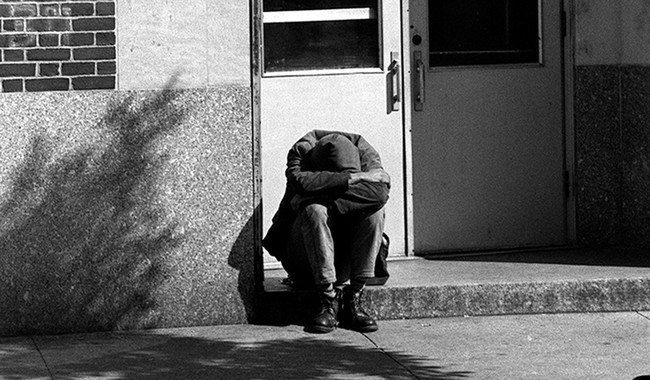
On any given night in America, rain or shine, warm or cold, more than 700,000 people, mostly in urban areas, are without shelter. It’s a problem that defies all attempts to alleviate it. It’s a problem that is only getting worse.
The problem of homelessness is partly mythological, partly a government flim-flam, and partly a human tragedy that government stupidity and political machinations make worse.
The first myth about homelessness is the notion that there isn’t enough money being spent to address the problem. If that were true, why did Los Angeles fail to spend more than half the money that the city allocated for the homeless?
The Los Angeles publication Westside Current states matter-of-factly, “The city left at least $473 million in homelessness funding unspent in fiscal year 2025-26, according to a new analysis from City Controller Kenneth Mejia’s office — the second straight year City Hall budgeted a massive homelessness response, then failed to spend anything close to the full amount.”
The city budgeted $1.1 billion for homeless programs.
Majia said: “For the second year in a row, the city ended up spending much less on homelessness than it promised. Often, most of the unspent money is rolled into the next year’s budget, but there are risks that some funds may be lost to other budget priorities. People need housing and services today, not a year or two from now.”
Why is that? There are several impediments to housing the homeless, most of which are the creation of well-meaning but incompetent bureaucrats who have a do-gooder complex and no idea of what actually afflicts the vast majority of homeless people: drug addiction and mental illness.
“Mainstream coverage of ‘homelessness’ is largely silent about drugs,” writes Heather McDonald in City Journal. “One might think these street colonists were an adult version of a Scout troop, simply preferring life outdoors to being inside.’
Indeed, “ignoring the obvious” is built into the homeless narrative. Pointing out that the vast majority of homeless people are drug-addicted or suffering from mental illness would destroy the government-industrial do-gooder complex that runs the nation’s “outreach” programs to the homeless.
In truth, the bureaucrats can’t dream up enough wild, wacky, and totally irrelevant programs to spend the money allocated to address the homelessness problem.
Eyewitness accounts of outreach efforts feature three groups: vagrants, social workers, and advocates. They interact against an otherwise emptied cityscape. The activists reliably complain that the city asks too much of the homeless and too little of itself.
The New York Times appears to have Dave Giffen, executive director of New York’s Coalition for the Homeless, on speed dial; his responses arrive on autopilot. “When these individuals have gone years, and have had every one of these systems failing them again and again and again, and not giving them what they actually need, you end up with people still outside in this cold,” he told the paper on January 27.
Giffen’s Times quote two weeks later had a familiar ring: “Unless you’re actually offering people what it is they want and need, it’s not going to do anything other than make it harder for people to survive day to day.” What they “want and need,” of course, are fully subsidized private apartments at taxpayer expense, with nothing, such as sobriety, expected in return.
I am not denying that there is a serious problem with housing the homeless. Homeless families with children are a growing problem that needs its own solutions. I am railing against liberal city governments, bureaucrats, radical activists, and the entire panoply of outreach programs, “innovative solutions,” and homeless shaming of the government-industrial do-gooder complex.
There were more than 187,000 homeless people in California as of 2024. New York has another 158,000, and Illinois and Massachusetts another 54,000. But only about 152,000 people nationwide are “chronically homeless.” The rest are homeless off and on, flitting between rehab and the street, or hospitals and the street. Or they are people whom family or friends were taking care of until their illnesses make them too dangerous or too unpredictable to remain housed.
The amount of tax dollars spent on ineffective programs is a disgrace to good governance.
Public discourse about homelessness rests on a category mistake as well as on empirical fictions. The error goes beyond the advocates’ successful rebranding of drug addiction, mental illness, and social disaffiliation as “homelessness.” We speak of “the homeless” as if it were an ontological category, one population set apart from everyone else. The term is not merely shorthand for individuals making persistently bad decisions. We do not hold “the homeless” to the same expectations as anyone else. They are treated as a different species. Of course they live on the streets; that is their essence.
Meantime, the roughly $80,000 the city spends annually on each street vagrant serves largely to preserve that status quo. The only policy that would restore public spaces to their rightful users is to prohibit their colonization by vagrants. Until about 60 years ago, it was simply understood that police would move transients along. Photographs of the New York subway system in the 1940s and 1950s show orderly spaces; commuters did not fear being pushed onto the tracks. Is poverty greater now than it was then? Hardly. Today’s poor receive levels of government support unimaginable in earlier eras. The fact that commuters must now contend with potentially lethal disorder is not a civilizational advance in the name of liberal autonomy; it is a step backward toward anarchy.
The tragedy of the homeless as a public policy problem is that the politicians, bureaucrats, and activists refuse to define the problem correctly, because doing so would expose their abject failure to address it. Homelessness is a problem that demands a revolution in the law, in the way government allocates funds, and in the way that we see homeless people.
Whatever we’re doing now isn’t working at all. Acknowledging failure is the first step finding a to a solution.
PJ Media will give you all the information you need to understand the decisions that will be made this year. Insightful commentary and straight-on, no-BS news reporting have been our hallmarks since 2005.
Get 60% off your new VIP membership by using the code FIGHT. You won’t regret it.