
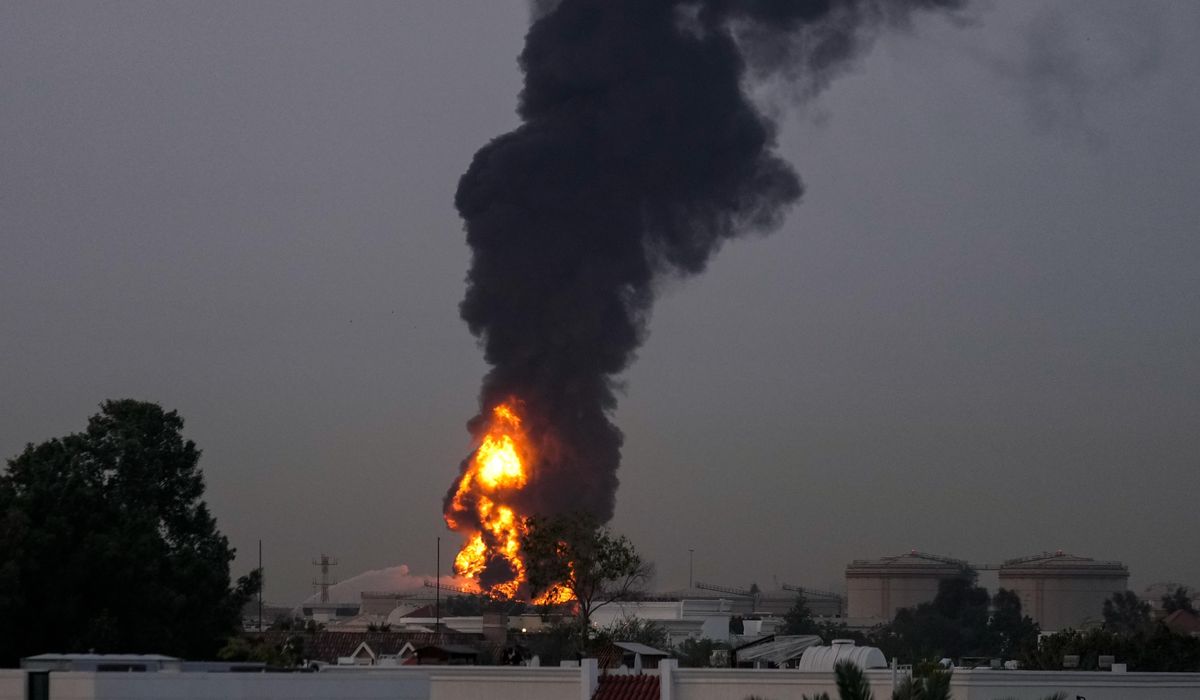
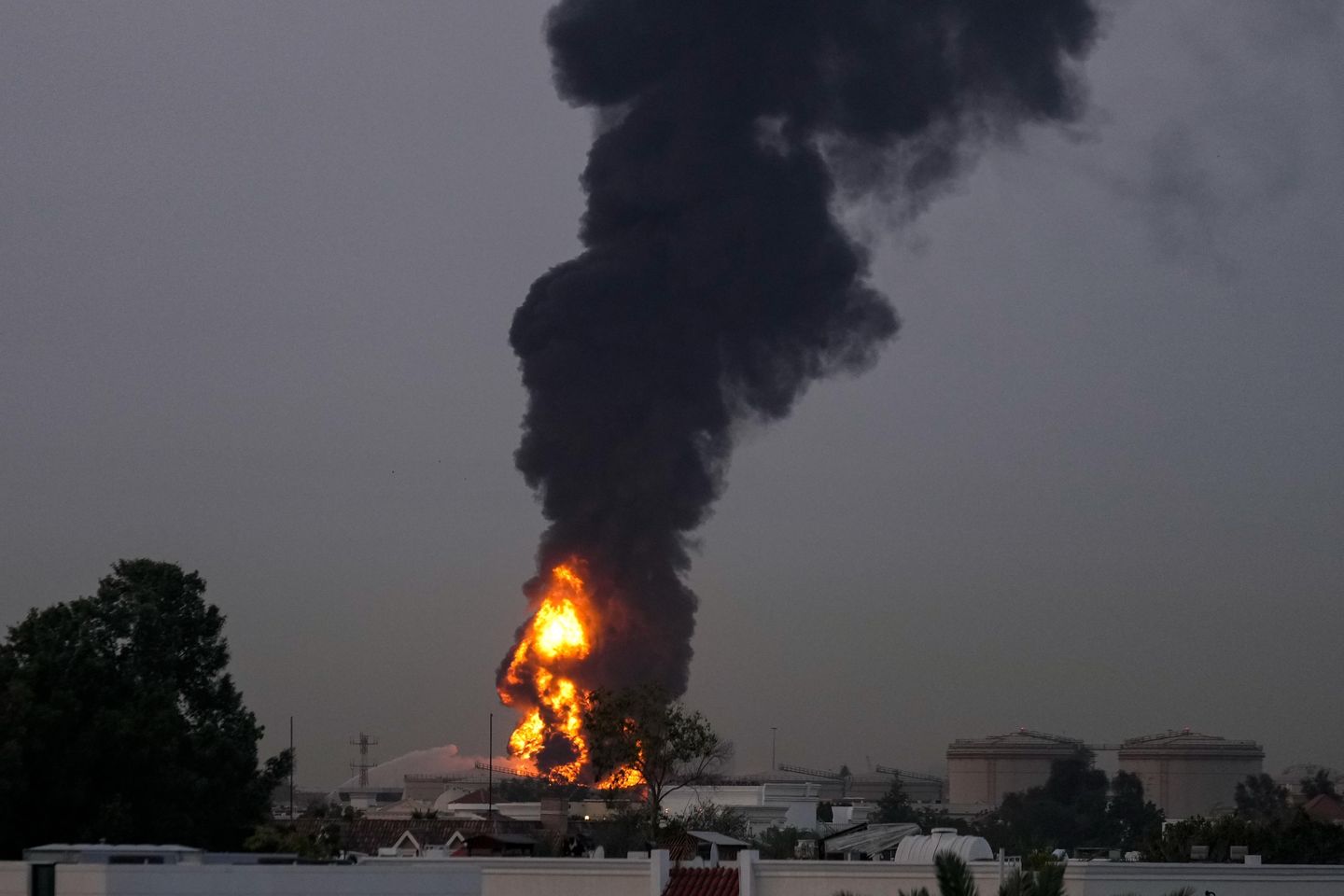
DUBAI — Iran hit oil production facilities across the Middle East for a second day, lashing out at Qatar, Saudi Arabia, the United Arab Emirates and Kuwait, despite attempts to de-escalate the spiraling conflict by U.S. President Trump, who a day earlier said he’d ordered Israel not to attack South Pars, Iran’s massive offshore natural gas reserve.
On Wednesday night, Mr. Trump threatened on social media to “blow up” all of South Pars if the Iranian attacks on Middle East oil production continued. However, Iran’s neighbors reported fresh missile and drone attacks on Thursday, sending oil prices skyrocketing with Brent crude ending the day briefly topping $110 a barrel.
Iran said its attacks across the region were retaliation for Wednesday’s Israeli airstrikes on South Pars, but the ongoing assaults are turning Gulf states against the besieged regime in Tehran.
Qatar expelled Iran’s military and security attaches Wednesday and gave them 24 hours to leave Doha after Iranian missiles struck Ras Laffan Industrial City, a gas processing and export complex on Qatar’s northern Gulf coast that handles roughly 20% of the world’s liquefied natural gas supply. It was the first formal expulsion of Iranian diplomats by a Gulf state since the war began.
Saudi Arabia reserved the right to military action the same day.
“What little trust there was has completely been shattered, on multiple levels,” Prince Faisal bin Farhan told reporters Thursday in Riyadh, the Saudi capital, hours after Iranian missiles targeted the city while Arab and Islamic foreign ministers were meeting there to discuss a way out of the war. A drone struck the SAMREF refinery — one of the kingdom’s largest crude processing facilities, located in Yanbu on the Red Sea coast — the same morning. “The level of accuracy in some of this targeting indicates that this is something that was premeditated, preplanned, preorganised and well thought out,” he said.
SEE ALSO: Rival opposition groups jockey for primacy in a post-regime Iran
Azza Hashem, managing director of the Al-Habtoor Research Centre in Dubai, said the UAE was not caught off guard. “Fully expecting this kind of asymmetric warfare, the UAE prepared for the statistical reality that some munitions would slip through,” she told The Washington Times.
Defense Secretary Pete Hegseth said Thursday at a Pentagon briefing that Iran had miscalculated. “Iran’s reckless attempt to strike civilian infrastructure has brought countries who maybe would not have been as all-in as they are today squarely into our orbit,” he said, naming the UAE, Qatar, Bahrain, Kuwait and Saudi Arabia.
Saudi Arabia hosted a consultative meeting of foreign ministers from 12 Arab and Islamic states Thursday. Their joint statement called on Iran to immediately halt strikes. The meeting was underway when the missiles landed.
Iran is no longer blocking only the strait. It is hitting the pipelines, terminals and gas fields the Gulf built specifically for this contingency.
When Iranian drones struck the Shah gas field — an ADNOC facility roughly 110 miles southwest of Abu Dhabi in the desert interior — on Monday and hit Fujairah for the third time this month, they targeted the infrastructure the United Arab Emirates spent $4.2 billion building to keep oil flowing if Hormuz ever closed. Fujairah is a port city on the UAE’s eastern coast, facing the Gulf of Oman rather than the Persian Gulf, which is precisely what makes it strategically significant — ships loading there never have to pass through the strait at all. UAE daily output is down by more than half. Fujairah’s crude terminals are suspended. The Shah field is offline.
The Abu Dhabi Crude Oil Pipeline runs 236 miles from the Habshan oil fields — the UAE’s main onshore processing hub, deep in the Abu Dhabi desert — east across the peninsula to Fujairah. Its capacity is 1.5 million barrels per day, roughly 60% of the UAE’s normal export volume. The remaining 40% moves through Hormuz. Iran has now targeted both routes.
SEE ALSO: Iran targets energy infrastructure in across Gulf after Israeli attack on South Pars
The pipeline carries crude oil only. Refined products, diesel, jet fuel and naphtha require separate infrastructure it does not provide. Roughly 30 percent of Europe’s diesel imports and half its jet fuel imports came from the Middle East entering 2026. Analysts are describing the result as a distillate crisis centered on Europe, not a Hormuz disruption.
The Shah gas field, operated by ADNOC — the Abu Dhabi National Oil Company — in a joint venture with Occidental Petroleum, supplied 20 percent of the UAE’s total gas supply and 5 percent of the world’s granulated sulfur before Monday’s strike. Shah’s sulfur feeds phosphate fertilizer producers globally. Urea prices have risen 25 percent in two weeks and are moving into food costs across South and Southeast Asia.
Only five oil tankers left the area on March 11. Around 500 remained stuck in the Gulf two weeks into the war. At least 16 vessels have been attacked. At least eight seafarers have been killed. QatarEnergy, Kuwait Petroleum Corporation and Abu Dhabi National Oil Corporation have all declared force majeure, the legal notification that a company cannot meet its contracts due to circumstances beyond its control.
Iranian drones and missiles have hit the Al Dhafra Air Base — a U.S. and French installation roughly 20 miles south of Abu Dhabi city that serves as Washington’s primary air operations hub in the Gulf, home to 3,500 troops — the Dubai International Financial Centre, the glass-tower district in the heart of Dubai that houses the regional headquarters of most of the world’s major banks, on two successive days, a fuel tank near Dubai International Airport on March 16 briefly closing the world’s busiest international aviation hub, the Shah gas field Monday and Ras Laffan Wednesday. Schools and universities shifted to remote learning on day one of the war. The government extended that order through at least April. The Ministry of Human Resources directed the private sector to keep workers away from open spaces over concerns about shrapnel from intercepted munitions.
Yara Aziz, a senior economist at OMFIF, the Official Monetary and Financial Institutions Forum, a London-based advisory body to central banks and sovereign funds, said the Gulf is caught in a paradox. Higher oil prices would normally mean more government revenue. This time the war pushing prices up is the same war blocking the ports that ship the oil. “When higher prices are driven by conflict that threatens export routes and energy infrastructure,” Ms. Aziz said, “the gains are offset by operational risks, shipping delays and logistical constraints.” She added: “Even if hostilities ease, damaged infrastructure, reduced shipping confidence and disrupted trade flows can persist.”
Goldman Sachs cut its 2026 Gulf growth forecast to 0.4 percent. Kuwait is projected to contract by 2.7 percent. Bahrain by 0.5 percent. JPMorgan cut non-oil growth forecasts by 1.2 percentage points across the region, with the UAE taking the steepest cut at 2.3 points. Three of the four largest Gulf economies have begun reviewing sovereign wealth fund strategies, weighing reversed investment pledges and divestments from overseas assets, Reuters reported March 11. Those funds collectively hold roughly $5 trillion, much of it in U.S. markets. S&P Global estimated Gulf banks could face $307 billion in deposit outflows if the conflict deepens.
Matthew McManus, adjunct professor of energy diplomacy at Georgetown University’s Walsh School of Foreign Service, said the gas picture has no equivalent safety net. “There is no strategic petroleum reserve for gas,” Mr. McManus said Thursday. Qatar’s Ras Laffan, built on Qatar’s northeastern coastline and expanded over three decades into the single largest concentration of LNG production capacity on earth, accounts for about 18 percent of global supply. American LNG will have to fill the gap. That substitution will take months and will raise prices in Europe and Asia before it helps.
Khalaf Al Habtoor, founder of the Al Habtoor Group, whose construction arm was part of the joint venture awarded a $790 million contract in 2008 to build Trump International Hotel and Tower on Dubai’s Palm Jumeirah — the artificial island that juts into the Persian Gulf off Dubai’s coastline, shelved in 2011 after the global financial crisis — addressed President Trump in an open letter on March 5. “Who gave you the authority to drag our region into a war with Iran?” he wrote. “You have placed the countries of the Gulf Cooperation Council and the Arab countries at the heart of a danger they did not choose.”
Anwar Gargash, diplomatic adviser to UAE President Sheikh Mohamed, condemned Iran’s targeting of Gulf states as reflecting “military failure, moral bankruptcy and political isolation.” He confirmed that “the UAE exerted sincere efforts until the very last moment to mediate between Washington and Tehran to avert this war.” A gap has opened between the long-term vision of the state and the view of some in the business community. The war has made it visible without resolving it.
Ms. Hashem said the UAE defense architecture held.
It combines THAAD and Patriot interceptors — American-built missile defense systems, the same ones ringing U.S. bases across the region — with hardened pipeline infrastructure and cyber defenses built with Google Cloud. Drone operators map damage berth by berth in real time, isolating compromised sections without shutting the entire port. The interception rate was approximately 95%. UAE engineers brought Fujairah’s key berths and its main supertanker jetty — the deep-water terminal capable of loading the largest crude carriers afloat — back online within 72 hours.
“This comprehensive resilience framework is exactly why the UAE, even while still under these unprecedented attacks, remains fully capable of transiting its oil from Fujairah and throughout the Gulf,” she said.
Damyana Bakardzhieva, Senior Research Fellow for Economic Diplomacy at the Anwar Gargash Diplomatic Academy in Abu Dhabi, said the strikes will accelerate ADNOC’s plans to build a second crude pipeline by 2027. The new line would run from Jebel Dhanna — the UAE’s main crude export terminal on the Arabian Gulf coast west of Abu Dhabi — east across the desert to Fujairah via the processing hub at Habshan.
The second pipeline would double UAE crude export capacity that bypasses the strait entirely, from the current 1.8 million barrels per day to more than 3 million.
Tehran has constructed legal cover for the closure. Iran’s non-ratification of the 1982 U.N. Convention on the Law of the Sea allows it to argue that only innocent passage applies in the Strait of Hormuz — the 21-mile-wide chokepoint between the Iranian coast and the Omani peninsula of Musandam through which a fifth of the world’s seaborne oil normally flows — giving Tehran claimed authority to stop any vessel it deems a security threat.
The strait is technically open under international law. It is effectively inaccessible in practice.
Washington has said it is not ready to escort commercial vessels through the strait. Naval assets are committed to active combat operations. Ambassador Joey Hood, former acting assistant secretary of state for Near Eastern Affairs, said the diplomatic infrastructure to manage the crisis barely exists.
“We have no ambassadors at all in Riyadh or Abu Dhabi,” Mr. Hood said Thursday. “In Kuwait, we not only don’t have an ambassador, we don’t have diplomats anymore.” Nineteen days of war involving twenty-five countries has produced neither a clear outcome nor an exit strategy from any of the three main belligerents. “A weakened regime with that ideology is a much more dangerous regime,” he said.
“Military tools are once again demonstrating their incapacity to impose durable peace in the region,” Ms. Bakardzhieva said.