
In the fall of 1980, a yellow school bus from Trimble County Middle School rattled down a gravel road somewhere in the sticks of northern Kentucky and let us off at what felt like the edge of the world. About twenty-five of us – mostly twelve- and thirteen-year-olds, all restless energy and muddy sneakers – piled out into the crisp October air. Our teacher, who knew the Hubbards personally, had promised us something different from the usual field trip. This wasn’t a museum or a factory. This was a living lesson.
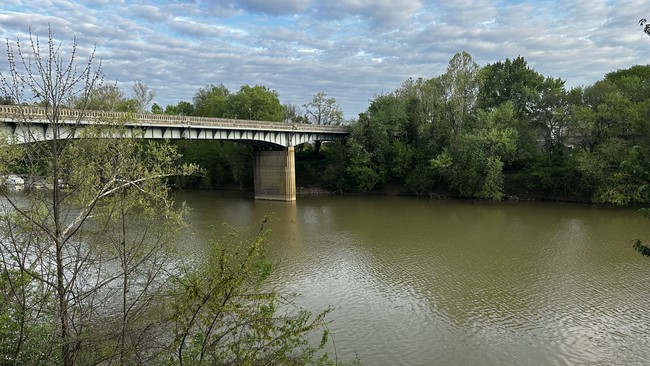
We hiked down a steep, leaf-strewn path through the trees, the Ohio River glinting below us through the branches. At the bottom, the trail opened onto a narrow rope bridge swaying gently over a creek. We crossed one by one, gripping the ropes, half-laughing, half-terrified the whole thing would give way. On the other side stood Harlan and Anna Hubbard’s place: a low, hand-built house high above the riverbank, surrounded by chickens scratching in the dirt, goats wandering freely, and ducks waddling toward us the moment Anna appeared with a bucket of feed.
She let us help scatter the grain, smiling quietly as hands shot out to grab fistfuls. Then we filed inside. The house was small, spare, and impossibly clean – every surface polished or whitewashed, every corner thoughtful. Sunlight poured through the windows and landed on a baby grand piano that dominated the living room like it belonged to a concert hall, not a river shack. Harlan’s paintings hung on the walls: soft river scenes, barges at dusk, the water and sky bleeding into each other in colors so calm they almost hurt to look at. Across the wide Ohio, on the Indiana shore, the skeletal frame of the unfinished Marble Hill Nuclear Power Plant loomed, contrasting with the Hubbard’s off-grid lifestyle.
Harlan himself was there, quiet, wearing overalls, hands that had built boats and houses and everything in between. He didn’t lecture us. He just let us look, let us feel the place. I remember standing in that room, surrounded by kids who were already whispering about lunch or recess, and thinking – even if I didn’t have the words for it yet – that I was seeing something rare. A man who had taught himself how to live fully, beautifully, without asking anyone’s permission.
Harlan Hubbard was, by any definition, an autodidact. He built his famous shantyboat and his home at Payne Hollow with his own hands, crafting a life of deliberate simplicity and quiet richness alongside his wife, Anna. They grew their own vegetables, tended chickens and goats for eggs and milk, foraged along the riverbanks, and supplemented their needs through the modest sales of Harlan’s paintings, woodcuts, and books, works that captured the river’s moods and their unhurried way of living. That day, I glimpsed something profound: a man who had chosen his own education, his own skills, his own path without waiting for institutional approval. Harlan Hubbard didn’t just live on the fringe of society; he showed how richly one could thrive there.
The Autodidact’s Rise
An autodidact is someone who claims ownership over their own learning. He decides what matters, seeks out the sources that matter most to him, sets his own pace and standards, and judges success by results that hold up in the real world, not by grades, diplomas, or someone else’s stamp of approval.
This is not casual hobbyism or occasional curiosity. It is sustained, disciplined pursuit, often driven by deep necessity, burning interest, or outright defiance of the usual routes. Autodidacts don’t wait for a syllabus or a professor’s lecture hall. They build their curriculum from books, experience, mentors they choose, trial and error, and whatever tools are at hand. When the world says, “You need this credential to be legitimate,” the autodidact answers by simply becoming competent, then proving it.
In short, autodidacts don’t ask the gatekeepers for a hall pass. They build the bridge themselves and then walk across it.
The many flavors of autodidacts reveal how diverse self-directed learning can be. Some chase breadth, others depth; some build empires, others display quiet defiance against the world’s control.
- Polymath / Renaissance: Benjamin Franklin and Leonardo da Vinci mastered multiple fields through relentless self-study; today, Elon Musk self-teaches rocket science and AI.
- Creative / Artistic Rebel: Vincent van Gogh painted thousands of works with almost no formal training; Quentin Tarantino learned film from video-store marathons.
- Tech / Entrepreneurial Gunslinger: Bill Gates built Microsoft through self-directed programming and business study; modern developers land jobs via YouTube, GitHub, and portfolios, no degree required.
- Philosophical / Intellectual Solitary: David Hume and Mark Twain shaped groundbreaking ideas through independent reading and reflection.
- Survivalist / Fringe: Henry David Thoreau’s Walden inspired Harlan Hubbard, who taught himself boat-building, farming, masonry, and painting while living simply off-grid.
- Rural / Working-Class / Redneck: My brother built his own gym equipment and uparmored vehicles in Afghanistan with scrap; my friend Bob, high-school educated, owned a vast eclectic library and could fix anything.
Of all the autodidact flavors, two are surging in 2026.
The Fringe Autodidact: Harlan Hubbard abandoned formal art training early and taught himself everything else through labor and necessity: boat-building for river drifting, masonry and carpentry for his hand-hewn home, farming and foraging for sustenance, painting and woodcuts to capture the world around him. At Payne Hollow, he and Anna created abundance without initial electricity or plumbing. Their baby grand piano stood amid shelves of Thoreau and Virgil in their hand-built house, Bach blending with reflected moonlight from the river in the evenings.
The Hubbards wrote polite, well-reasoned letters protesting the Marble Hill Nuclear Power Plant to local papers in Trimble County and Madison, Ind., but their true opposition was embodied in their self-sufficient life. Wendell Berry, an active protester arrested at the site in 1979, noted that the Hubbards had opposed it longer than anyone, not through confrontation, but by living abundantly with no need for the electricity such a plant promised. Marble Hill collapsed in 1984 under cost overruns and flaws; the Hubbards’ alternative endured. Fringe autodidacts model integrated high culture and intentional independence in an age of overbuilt systems.
The Redneck Autodidact: This is the most practical, necessity-forged flavor: the hedge engineers of everyday life. They grasp structure, composition, and physics on a gut level, even if they can’t name the formulas. My brother built his own weight equipment from scrap as a teenager, kept cars running through pure trial and error, and later uparmored his squad’s vehicles in Afghanistan with whatever metal and tools were at hand. Old Bob, high-school educated, read a vast personal library cover to cover and could repair anything mechanical or electrical.
These men might not quote Ohm’s Law, yet they can rewire a truck to add spotlights and running lights or swap out a V8 for a vintage V12. They might never mention Archimedes, but they can frame a barn that stands straight for generations while the average contractor’s work sags. Think Travis Taylor, the “redneck rocket scientist,” or farmers who master precision agriculture from YouTube tutorials. Redneck culture has always judged by one standard only: competence. Fix the truck, wire the barn, or keep the fridge stocked with home-butchered venison, and you’re qualified. No paperwork required.
Why They’re Rising Fast in 2026
Credentialism is collapsing – higher ed faces enrollment declines (projected 13–15% through the 2030s), eroding trust, debt burdens, and questionable ROI amid ideological bloat. Degrees often signal conformity over skill.
Online democratizers fill the gap: YouTube, Khan Academy, AI tutors, and open resources put knowledge in anyone’s reach. The World Economic Forum projects 39% of core skills changing by 2030, with “learning how to learn” essential. Autodidacts excel here. Fringe types offer models of voluntary simplicity; redneck ones deliver practical innovation under constraints. And every autodidact is a font of creativity, reaching across specialties to innovate, invent, and imagine.
These flavors were built for the rising reality. They are outside the gatekeepers and unstoppable by traditional means, rooted in defiance and results. The credentialed class holds old keys, but the doors stand open now, with education accessible to any who have the will to learn. Fringe and redneck autodidacts aren’t requesting entry, hat in hand. They’re already building the next world, one hand-hewn home, one fixed engine, one self-taught skill at a time.
The credentialed class keeps telling us to wait: wait for the next degree, the next certification, the next expert-approved path. But Harlan Hubbard didn’t wait for a gallery to hang his paintings or a utility company to wire his home. He built the life he wanted with his hands, his mind, and his refusal to bow. My brother didn’t wait for an engineering degree to uparmor vehicles in a war zone. He and other self-taught innovators turned scrap into salvation. Bob didn’t wait for a PhD to fill his shelves and fix what needed fixing. They acted. They built.
And that’s the quiet revolution we’re seeing now. The redneck autodidact isn’t a nostalgic footnote or a fringe eccentric. He’s the prototype for what comes next. In garages, backyards, riverbanks, and online forums, ordinary Americans are reclaiming knowledge the way it’s always been reclaimed: through necessity, curiosity, and sheer competence. They don’t ask gatekeepers for permission slips. They don’t rack up debt for a paper that might never pay off. They learn what works, prove it in the real world, and share it freely.
The dragons of credentialism and conformity are bleeding. The autodidacts have seen them fall before. They won’t be ruled by them again.
Recommended: The World as It Is: The Structure of Conservative Art
Editor’s Note: PJ Media is free to bring you this kind of cultural content because our loyal subscribers help support us in a media and online environment hostile to what we stand for. Join PJ Media VIP and use the promo code FIGHT to get 60% off your VIP membership!