

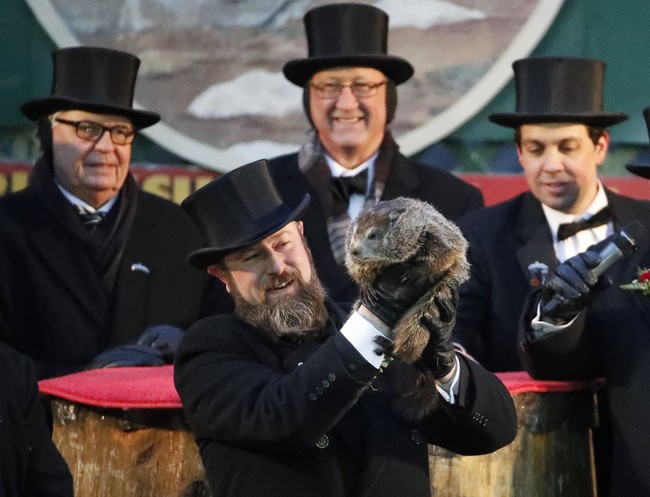
Winters, especially this one, feel endless. Darkness lingers, the cold bites, and people search for any sign that spring might come soon. Sometimes, that sign comes in the form of a small animal stepping out of its burrow.
A groundhog.
Roots in Old Traditions
German immigrants in the 1700s and 1800s brought Groundhog Day to America, a custom from Europe tied to Candlemas, a Christian holiday on February 2, marking the midpoint of winter.
In German-speaking areas, people watched critters such as badgers and hedgehogs to see if they saw their shadow on a sunny day. Their shadow represents six more weeks of winter. If they didn’t see it, then spring would arrive early.
There weren’t any badgers or hedgehogs living in Pennsylvania, so settlers chose the groundhog, a local burrowing animal that hibernates. The tradition fit the land and gave farmers a taste of the old country while facing long winters.
From Farm Custom to Official Event
The first recorded Groundhog Day was an informal celebration held in 1886 in Punxsutawney, Penn., as reported in the local newspaper. In 1887, members of the Punxsutawney Groundhog Club made it formal, gathering at Gobbler’s Knob, named their groundhog Punxsutawney Phil, and turned the event into a formal ceremony, with top hats and dramatic proclamations.
The first Groundhog Day celebration in Punxsutawney was the brainchild of local newspaper editor Clymer Freas, who sold a group of businessmen and groundhog hunters, known collectively as the Punxsutawney Groundhog Club, on the idea. The men trekked to a site called Gobbler’s Knob, where the inaugural groundhog became the bearer of bad news when he saw his shadow.
According to the club, Phil is the same groundhog every year, thanks to a secret “elixir of life.” Obviously, with a lifespan of around six years, different groundhogs have played the role over the years.
Many Groundhogs, One Big Tradition
Today, several dozen weather-predicting groundhogs appear across the United States and Canada, some real animals, others statues or people in costume. Among the more famous include Staten Island Chuck in New York, General Beauregard Lee in Georgia, Jimmy in Wisconsin, Buckeye Chuck in Ohio, and Wiarton Willie in Ontario, Canada.
A similar pattern plays out at each event: the groundhog emerges at dawn, handlers “interpret” whether they see their shadow, and a proclamation declares either six more weeks of winter or an early spring.
The Accuracy Question
Yet, just how accurate is a groundhog’s prediction? According to the National Oceanic and Atmospheric Administration (NOAA), Punxsutawney Phil’s forecasts match actual U.S. forecasts only about 35% of the time over the past few decades, ranking lower than others: Staten Island Chuck scores around 85%. On average, the predictions do no better than a coin flip.
Why It Still Matters
Groundhog Day is truly nothing serious: no law changes, no plan shifts, and nobody is blamed if it’s wrong. People gather, smile, and go about their day.
Farmers in the past used such events to break the boredom of winter and build community spirit, while today people still show up for the same reasons: it’s harmless, familiar, and brings people together.
The porch light flicks on at dusk, the cold hangs on, and somebody watches for that small sign, hoping warmer days lie ahead.
Final Thoughts
A critter peeking into the light never promised perfect weather, but the ritual offers something better: a shared laugh, a touch of continuity in a changing season, and the permission to be wrong as a group.
That simple promise outlasts any forecast.
PJ Media VIP supports writers who focus on clear thinking, real history, and honest questions instead of hype. Subscribing helps keep thoughtful, in-depth pieces alive and preserves cultural stories that still count.