

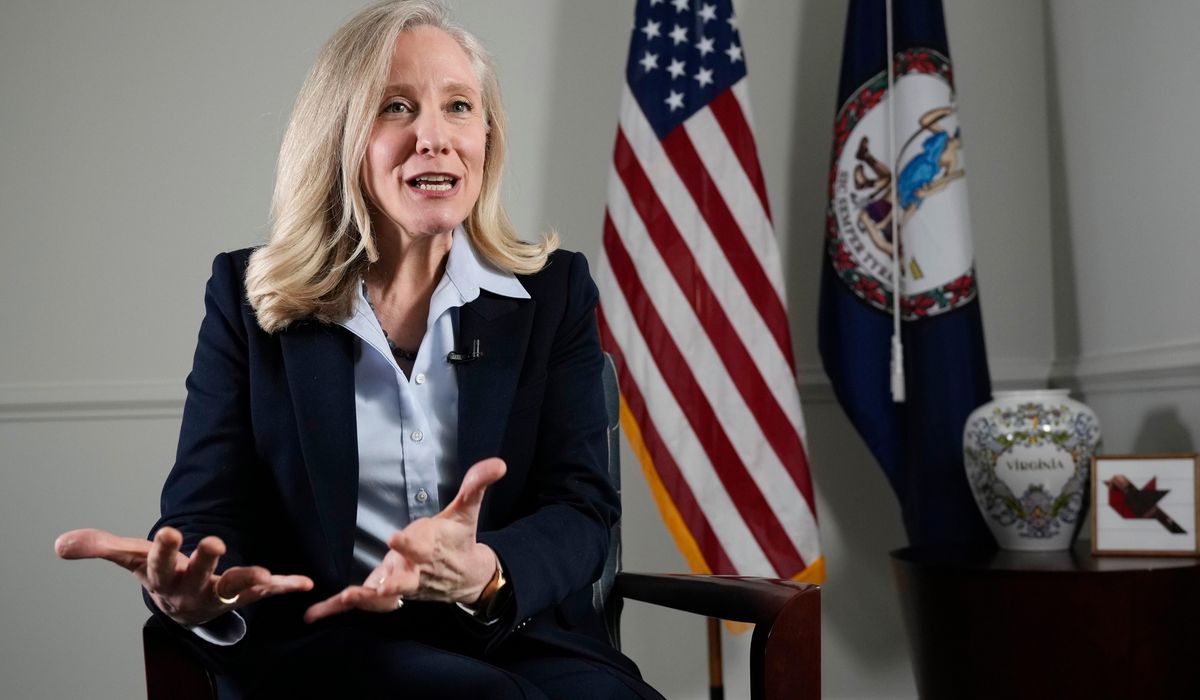
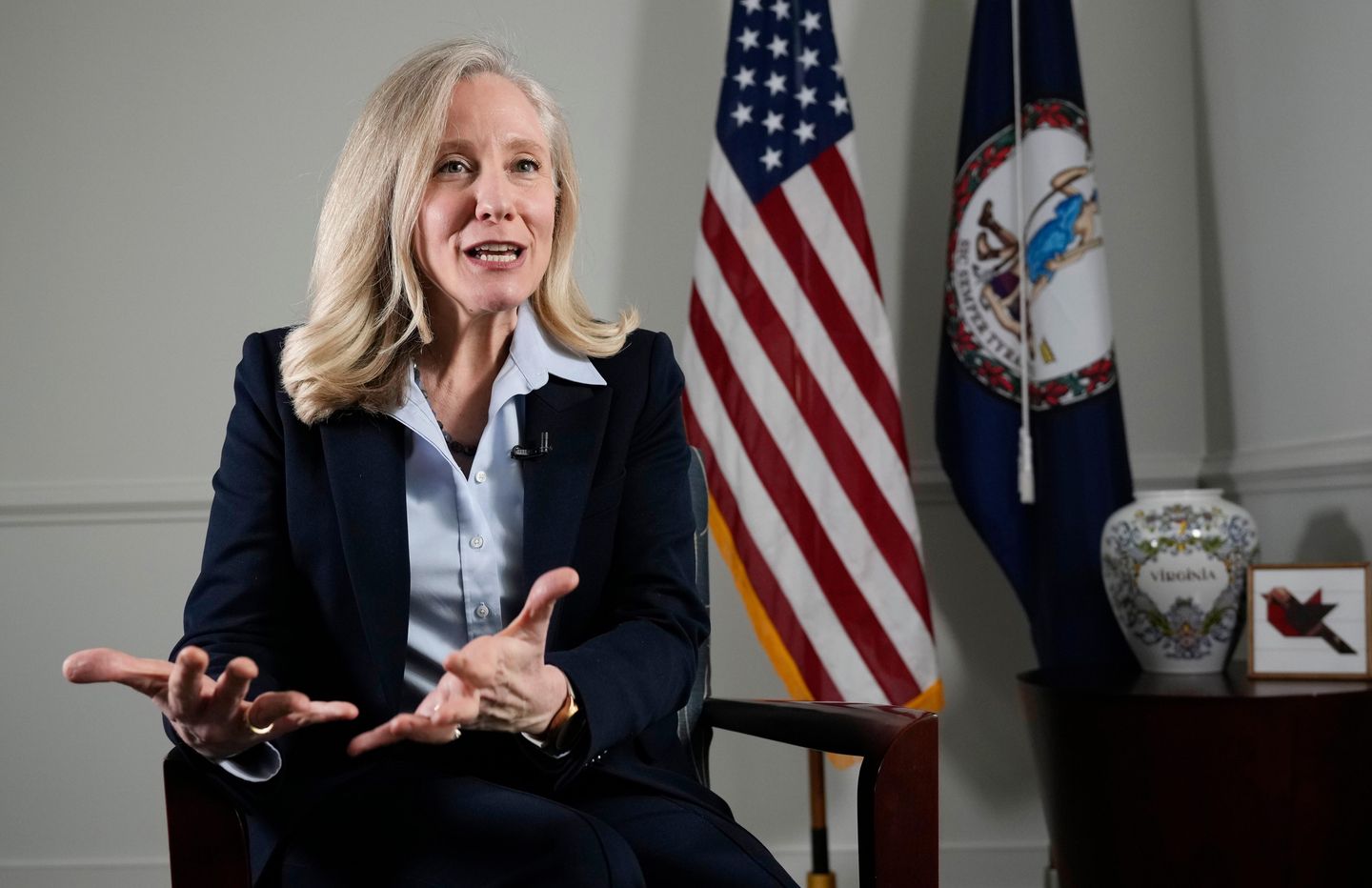
Abigail Spanberger is set to make history Saturday when she becomes Virginia’s first female governor, opening a new chapter in Richmond as Democrats prepare to control every lever of state government for the next two years.
Ms. Spanberger — a 46‑year‑old former congresswoman, former CIA officer and mother of three daughters — will take the oath of office on the Capitol steps as Virginia’s 75th governor, with dignitaries looking on and all the pomp and circumstance that comes with the quadrennial transfer of power.
Her swearing‑in formally closes the book on Republican Gov. Glenn Youngkin’s term and caps a swift political reversal in Richmond, where Democrats swept statewide races and expanded their legislative majorities, leaving pro‑life, pro‑Second Amendment and anti‑tax advocates uneasy about what lies ahead.
“I think voters put us in charge to focus on affordability and bring some rationality and stability to what’s going on across the [Potomac] River,” Senate Majority Leader Scott Surovell told The Washington Times, nodding to President Trump and the turbulence in Washington.
Republicans, meanwhile, are sounding the alarm, saying Democrats are pushing tax-and-spend policies that will hurt small businesses and families, impose job-killing mandates and sell out Virginia’s economy to left-wing special interests.
Ms. Spanberger coasted to a landslide win after promising to tackle the rising costs of health care, housing and energy, which have been squeezing families across the commonwealth.
She enters office with a budget surplus and steady job growth, but also with looming fiscal headwinds: federal cuts to Medicaid and food assistance programs and the fate of Affordable Care Act subsidies under debate in Washington.
Democrats have previewed their agenda.
Ms. Spanberger and legislative leaders rolled out an “Affordable Virginia” agenda to lower health insurance and prescription drug costs, reduce utility bills and help renters and homeowners stay afloat.
“These are the steps we are taking to deliver on the promises I made on the campaign trail,” Ms. Spanberger told Fox News 5.
Her victory capped an off‑year election in which Democrats also flipped the attorney general and lieutenant governor’s offices and expanded their House majority from 51 to 64 seats. The party had been hoping for such a result since Mr. Youngkin’s surprise win four years ago.
For Democrats, it feels like picking up where they left off under Gov. Ralph Northam, who handed the keys to Mr. Youngkin four years ago.
In the final two years of the Northam administration, the party held a governing trifecta and went hog-wild by abolishing the death penalty, legalizing marijuana, expanding gun background checks and approving a $12 hourly minimum wage.
Ms. Spanberger now steps into a similar position, marking only the second time in three decades that Democrats have controlled both legislative chambers and the governor’s mansion, opening the door for them to pursue some thorny proposals, including a mid-decade redistricting plan in response to Trump-led efforts elsewhere.
Still, longtime Democratic strategist Ben Tribbett expects a measured approach from Ms. Spanberger, who has long branded herself as a moderate, and at times found herself in the crosshairs of the party’s liberal base.
“I don’t think people are going to see radical change,” he said, predicting Democrats will revive legislative efforts that Mr. Youngkin blocked with his veto pen. “This is not going to be like the 2020 session when progressives got everything they wanted.”
That means renewed pushes to set up a marijuana marketplace and enact new gun restrictions. These proposals have drawn fierce opposition from Second Amendment advocates. Democrats want to ban so-called assault weapons and high‑capacity magazines, strengthen safe‑storage laws and impose a five‑day waiting period for gun purchases.
They are also eyeing a casino in Fairfax County, a $15 hourly minimum wage by 2028, paid family and medical leave for midsize employers and a new delivery fee to help fund Metro.
Their priorities include expanding access to solar energy, including balcony panels, loosening local restrictions on residential construction, restoring collective bargaining rights for public employees, and allowing localities to impose a 1% sales tax for school construction with voter approval.
They also will continue to juggle the state’s role in data center management.
The shift leaves Republicans largely sidelined after Mr. Youngkin spent four years as the party’s backstop. He vetoed 399 bills, shattering the previous record of 120 set by Democratic Gov. Terry McAuliffe.
Philip Van Cleave, president of the Virginia Citizens Defense League, said the new dynamic is a bit of a nightmare because he has little faith Ms. Spanberger will stick up for gun owners.
“As I’m watching her sworn in, I know that we’ve got four more years of watching our backs on gun rights,” he said. “This is all about harassing gun owners, and the ultimate goal is about civilian disarmament.”
Ms. Spanberger will now have to navigate between her own priorities and the ambitions of the party’s energized left flank.
Lawmakers have already filed bills that would, among other things, enact a millionaires’ tax and increase corporate taxes. Some are also pushing to repeal Virginia’s right‑to‑work laws, a move Ms. Spanberger has signaled is off the table, though she has expressed support for allowing state employees to collectively bargain.
In his final State of the Commonwealth address, Mr. Youngkin urged Democrats to follow his lead by holding the line on taxes and new regulations. He warned that reversing course could slow economic growth and drive away businesses.
He said Democrats are introducing legislation “raising nearly every tax known to man” for the General Assembly session that kicked off Wednesday.
“One thing we have clearly demonstrated is that lowering tax burdens brings people, businesses and jobs. Increasing taxes drives them away,” he said. “Just look at California and Illinois, New York and Maryland.”
Democrats wasted no time flexing their new power.
On opening day, House lawmakers passed four constitutional amendments to enshrine abortion rights, strike a defunct 2006 same‑sex marriage ban, restore voting rights to felons who have completed their sentences and give the legislature, not a bipartisan commission, control over redrawing congressional districts.