
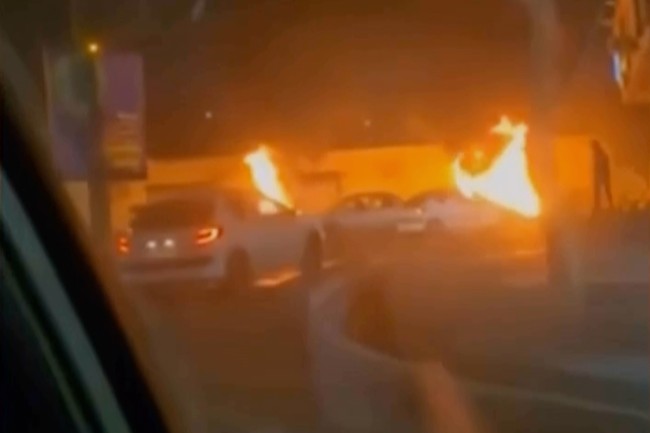
As Donald Trump weighs his options on Iran, it’s clear that these protests are different from every other uprising in Iran since the 2009 “Green Revolution” following the rigged presidential election that returned Mahmoud Ahmadinejad to power.
Every two or three years after that, there were massive street protests that ended with the inevitable crackdowns. Dozens of protesters were killed, and tens of thousands of demonstrators were arrested.
The 2019 protests over gas prices gave rise to the 2022 “Women, Life, Freedom” protests. What marked these popular uprisings was their narrow support among the population as a whole: the young, the educated, the middle class, and restive minorities looking to break their chains participated, while most of the country sat on the sidelines.
This time, it’s different. After turning off the internet and international phone calls, the regime imported fanatical Shi’ite militias from Iraq, including Kata’ib Hezbollah, to do their “wet work.” The results are sickening.
Estimates of the dead vary from a high of 12,000 dead from the anti-regime group, Iran International, to Human Rights Activists in Iran (HRII), who place the total number of dead protesters at a little over 1,200. Time Magazine reported figures may be as high as 6,000.
Kerman; “Javidshah Javidshah” pic.twitter.com/DzfWakAl8D
— Manoto Newsroom (@ManotoNews) January 9, 2026
The ISW believes the number of dead security personnel is much higher.
“The actual death count for Iranian security personnel is likely higher than the number that IRGC-affiliated media reported, given that CTP-ISW [Critical Threats Page] has observed reports of security personnel casualties in areas, such as Tehran Province, that IRGC-affiliated media did not include in its death count,” the Institute reported.
Middle East Forum (MEF):
“People came out in families, across all age groups,” he said. “There are no landlines, no mobile networks, no internet access, yet people remain coordinated. They know where and when to gather.” The primary chants, he said, were “God save the shah!” and “Pahlavi will return!”
Multiple videos circulating from inside Iran show bodies laid out on hospital floors in Fardis, roughly twenty-five miles west of Tehran, as well as in Shiraz.
A video circulating on social media shows an individual saying the footage was recorded on January 9 in Mashhad, documenting the situation inside a hospital and the condition of people wounded during the protests.
A video has been posted on social media in which a person in the video, saying the date was January 9 in Mashhad, shows the condition of a hospital and the injured protesters. Protests intensified across Iran yesterday despite the internet outage. There have also been reports of a number of protesters losing their lives. pic.twitter.com/Tt4OQ9sDHA
— Manoto Newsroom (@ManotoNews) January 10, 2026
Another big difference this time around is that Iranians from all classes, all walks of life, all ethnicities, are engaged, and are using everything, including their hands and teeth, to fight the regime.
Behind the blackout, as is clear from video and audio files that continue to trickle out, more protesters are dying, more public buildings are being attacked and more hospitals are becoming war zones as parents smash down mortuary doors and remove the bodies of their dead children before the authorities can surreptitiously bury them. Such confrontations are a throwback to the 1979 revolution, which advanced to the rhythm of Shia mourning ceremonies, each funeral being a magnet for more protests and more deaths.
Only a few government services — notably regime propaganda conducted through social media — have been exempted from the blackout. Card transactions, on which the economy depends, have not. With shops shuttered, the protests seem to be growing. In one video clip of a huge nocturnal gathering, a voice is heard: “They say they are going to come and kill us. Let them try to kill this crowd!”
As always when reporting on events in Iran, the reader must weigh for himself how much of what is being read is exaggerated, erroneous, or pure propaganda. This is especially true when reading about an Iran that is almost totally cut off from the outside world.
But as with all massacres, there are survivors. And the man directly responsible for the nauseating slaughter, Ayatollah Ali Khamenei, knows that losing power means losing his life. He will hang on to the bitter end, bringing his nation to ruin in an eerie echo of Hitler’s Gotterdämmerung at the end of his regime, rather than surrender or flee his country.
Khamenei lost the use of an arm when he was blown up early in the revolution. He is not a quitter but a quietly stolid fanatic who will leave the Islamic Republic horizontally or not at all. And he has yet to turn the full force of his killing machine on the protesters. Observing all this, and fanning his tail feathers after his exfiltration of Nicolás Maduro from Venezuela, is the US president — who, by immediately reimposing his policy of “maximum pressure” on the Islamic Republic following his election last year, has, it is now clear, helped bring the Islamic Republic to its knees. “If they start killing people like they have in the past,” Trump declared on Saturday, “we’ll be hitting them very hard where it hurts.” By that time, of course, the slaughter of protesters was well underway.
Trump is gauging when U.S. intervention would make the maximum impact before acting. His actions will mean the difference between success and failure for the millions of Iranians now in the streets demanding Khamenei’s ouster.
The new year promises to be one of the most pivotal in recent history. Midterm elections will determine if we continue to move forward or slide back into lawfare, impeachments, and the toleration of fraud.
PJ Media will give you all the information you need to understand the decisions that will be made this year. Insightful commentary and straight-on, no-BS news reporting have been our hallmarks since 2005.
Get 60% off your new VIP membership by using the code FIGHT. You won’t regret it.