
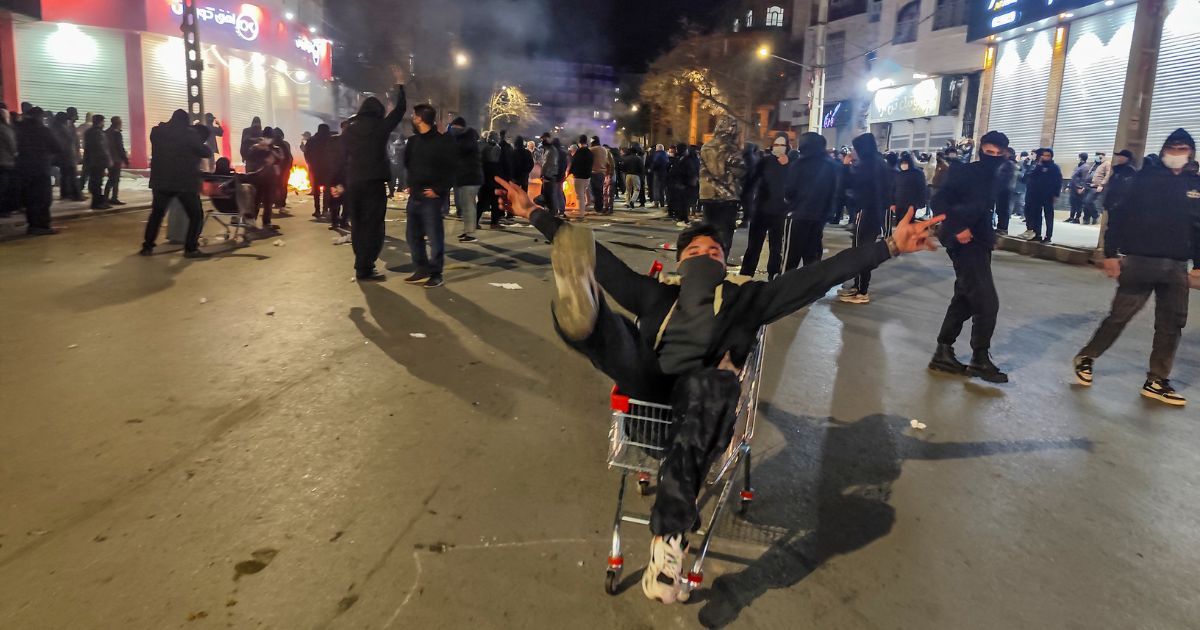
Iran responded to escalating protests across the nation Thursday with an internet blackout.
As noted by The Washington Post, cutting Iran off from the outside world is often the first step in a government crackdown.
Rising unrest that filled the streets in multiple Iranian cities appeared to be fueled by a call for protests issued by Crown Prince Reza Pahlavi, the son of the Shah of Iran who fled the nation after the 1979 Islamic Revolution.
An unverified video posted to social media showed the pre-revolution flag being waved; the post claimed this was done at a recent Iranian protest.
Islam is falling in tehran, protestors are now hoisting the old persian flag with Lion and Sun at the centre !! 🥵🔥#Iran #IranProtests
— ⚡Rampage⚡ (@endhi_peekedhi) January 8, 2026
The protests began 12 days ago due to economic conditions, and have since spread as a broad but unfocused show of anger at the Islamic regime.
“The Iranian government uses internet shutdowns as a tool of repression,” Omid Memarian, an Iranian human rights expert, said, according to The New York Times.
“Whenever protests reach a critical point, authorities sever the country’s connection to the global internet to isolate protesters and limit their communication with the outside world,” he added.
“We are in a situation that can be described as a near-total internet shutdown,” Amir Rashidi, director of digital rights and security at the Miaan Group, a U.S.-based human rights organization focused on the Middle East, said.
Prior to the blackout, Iran’s security chief said protesters would face stern measures if the 12 days of demonstrations continued.
“The evidence shows that the scope of the crackdown is becoming more violent and more extensive every day,” Iranian Human Rights Director Mahmood Amiry-Moghaddam said, according to The Guardian.
As the protests escalated, President Donald Trump repeated his demand that Iran not use past tactics of mowing down protesters to quell civil disobedience.
“I have let them know that if they start killing people, which they tend to do during their riots — they have lots of riots — if they do it, we are going to hit them very hard,” Trump told High Hewitt, according to the BBC.
“We’re watching it very closely,” he said. “They know, and they have been told very strongly, even more strongly than I am speaking to you right now, that if they do that they are going to have to pay hell.”
Trump shared a message with protesters: “You should feel strongly about freedom… You’re brave people. It’s a shame what’s happened to your country. Your country was a great country.”
Why hasn’t Greta Thunberg said anything about the protests in Iran?
For 11 days now, Iranians have been bravely fighting a terrorist Islamic regime. At least 35 people have been killed. I thought she cared about human rights. pic.twitter.com/mThUMFCJrz
— Dr. Maalouf (@realMaalouf) January 8, 2026
As noted by BBC writer Amir Azimi, “The last time Iran experienced unrest on a comparable national scale was around four years ago, when the death of Mahsa Amini, a young woman in the custody of the morality police sparked the most widespread anti-government protests since the establishment of the Islamic Republic in 1979.”
“Those demonstrations, which later became known as the ‘Mahsa Movement’ or ‘Woman, Life, Freedom,’ shook the foundations of the state but were eventually suppressed through force and mass arrests,” he wrote.
He wrote that “many observers believe the present situation could have more serious consequences than 2022. Iran’s government is widely seen as being at its weakest point in decades, facing simultaneous pressure from domestic unrest and a dramatically altered regional environment.”

Advertise with The Western Journal and reach millions of highly engaged readers, while supporting our work. Advertise Today.