
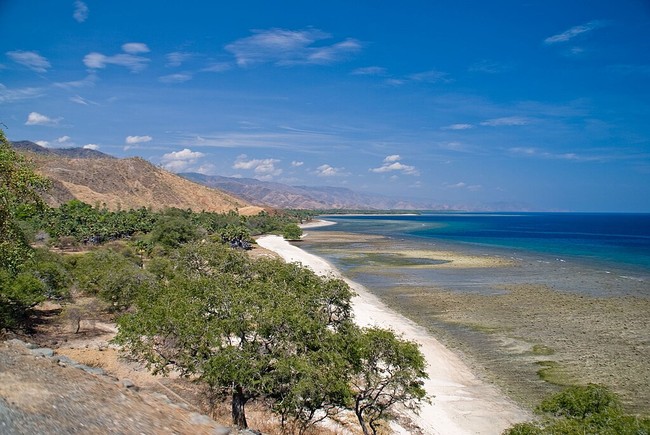
The island nation of Timor-Leste, located north of Australia at the eastern extreme of the Indian Ocean, is blessed with stunning beaches along a rugged mountainous terrain. It is famous for producing some of the world’s finest organic coffee, grown in high-altitude, shaded environments, producing a smooth, low-acid brew with notes of chocolate, cocoa, and spice.
Just a little smaller than Texas in land area, the country of 1.3 million people is at a pivotal moment, ready to challenge a popular – if perhaps fading – narrative that cripples some developing economies – the unfounded fear of man-made climate catastrophe.
For years, alarmists have singled out low-lying island nations as poster children for the looming disaster of being swallowed by a warming globe’s rising seas. The “solution” – presented as a moral imperative – was to abandon the use of fossil fuels, whose emissions of carbon dioxide supposedly were to blame for melting glaciers and drowning coastlines.
However, Timor-Leste has chosen a radically different, and far more honest, path: unapologetic economic growth fueled by its natural resources, including abundant fossil fuel reserves.
On October 26, Timor-Leste entered the Association of Southeast Asian Nations as the eleventh member state during the 47th ASEAN Summit in Kuala Lumpur. Now, with access to 680 million potential consumers in Southeast Asia, Timor-Leste has the chance to multiply by many times its $21 million in non-oil exports and establish itself as a reliable regional partner.
But this opportunity only bears fruit if Timor-Leste can power its economic transformation with affordable energy. Hence, the country has planned $1 billion in investments that embrace the very resources climate activists want left in the ground.
For example, $194 million has been allocated for the development of natural gas deposits and liquefied natural gas production. “We will continue to capitalize on our petroleum and mineral wealth … supporting critical projects,” said Prime Minister Kay Rala Xanana Gusmão.
The country sits atop significant hydrocarbon reserves that represent its best chance at economic transformation. According to the Timor-Leste National Petroleum and Mineral Authority, the nation possesses oil reserves of 8.3 billion barrels and natural gas reserves of 324 billion cubic meters. Current oil production stands at approximately 60,000 barrels per day, with production capacity estimated to be more than double that.
The Petroleum Fund, which held almost $19 billion as of the third quarter of 2025, demonstrates what resource development can achieve. Since its establishment in 2005, the fund has generated total revenue of approximately $25 billion, with nearly $12 billion coming from annual investment returns averaging 4.7%.
Timor-Leste is also pursuing mineral exploration to complement its petroleum sector. Target minerals include copper, gold, manganese, chromite, zinc, and silver, along with industrial minerals like limestone, marble, kaolin, and potentially phosphate. Recently, there was a discovery of high-grade manganese, which is essential for both producing steel and manufacturing batteries.
The discourse of climate ideology paints small island states as “victims” of climate change, with disappearing land, forced relocation, and impoverishment. That narrative is false and a trap. It condemns these nations to a permanent “climate trauma” that denies their potential as productive members of the world community.
Timor-Leste itself has been branded a victim-in-waiting, but reality contradicts this manufactured crisis. Sea level has been rising since the end of the last major glacial period 12,000 years ago. And while occasional cold periods have paused or even reversed this increase in sea level, the long-term trend has been higher.
The relevant question is whether the rise has been accelerating with modern warming, and the answer from worldwide tide-gauge data is that it has not. Even more damaging to the alarmists’ narrative is evidence that many islands have grown in size through natural processes as seas have risen. The Pacific island of Tuvalu, for instance, gained 180 acres over a 40-year period.
Denying facts in plain view, climate orthodoxy considers poverty in the Global South to be acceptable if it serves to reduce emissions of carbon dioxide from fossil fuels. Timor-Leste has rejected this poisonous logic, instead setting itself up to be part of a global supply chain for important fuels and minerals.
The true threat to the people of Timor-Leste is not a slightly warmer world or a few millimeters of sea-level rise; it is economic decline from a lack of affordable, reliable energy like that derived from coal, oil, and natural gas.